Identification
Mold in the Bathroom: Ceiling, Grout and Caulk — What's Normal and What's Not
Black spots on shower caulk are usually harmless mildew. Bathroom ceiling mold is a different story. How to tell them apart, clean safely, and stop regrowth.
Fast facts
- Is mold in the bathroom normal? A thin film of dark speckling on grout, caulk and shower corners is extremely common in any bathroom that gets used daily — it's surface mildew feeding on soap film and moisture, and it wipes off.
- Is bathroom ceiling mold the same thing? Not usually. Growth spreading across a ceiling or high on a wall means humid air is sitting in the room too long, or water is getting in from above — that's a building problem, not a cleaning problem.
- Is the black stuff in shower grout dangerous black mold? Rarely. Grout and caulk staining is typically ordinary mildew or a mix of common molds and soap scum, not Stachybotrys, which needs soaked porous material like drywall.
- What actually stops it coming back? Moving the moist air out — a properly sized fan run 20–30 minutes after every shower, plus squeegeeing and drying wet surfaces.
- When should I call a professional? If growth covers more than roughly 10 square feet, keeps returning after real fixes, follows a stain or sag in the ceiling, or anyone in the home has ongoing symptoms.
The bathroom is the single most photographed room in mold questions, and for good reason: it's the one place in a house where you deliberately create a warm, wet cloud several times a day. Some of what grows there is cosmetic. Some of it is telling you something about your ventilation or your plumbing. The trick is knowing which is which before you spend a weekend scrubbing the wrong thing.
Why bathrooms grow mold in the first place
Mold needs three things: spores (already everywhere, in every house), something to eat, and moisture. In a bathroom, the first two are free. Spores ride in on air and towels. Food is soap scum, body oils, shampoo residue, skin cells, and the organic additives in some caulks and paints.
So moisture is the only variable you control. A single 10-minute hot shower can push a small bathroom past 90% relative humidity. If that moisture leaves the room in 20 minutes, nothing grows. If it lingers for hours — condensing on the coolest surfaces, soaking into the paint film — you've built a greenhouse.
That's why the location of growth tells you more than the color does.
Surface mildew vs. a moisture problem: a quick comparison
| Everyday surface mildew | Ceiling / wall growth (a signal) | |
|---|---|---|
| Where | Grout lines, silicone caulk, shower corners, under bottle rims, around the drain | Ceiling above the shower, ceiling center, corners, upper walls, behind the toilet |
| Color | Black dots and streaks, sometimes pink or orange slime | Gray, greenish-black, or brown; sometimes fuzzy white or a dark halo around a stain |
| Texture | Flat, thin, in the seams; wipes off onto a cloth | Blotchy, sometimes fuzzy or raised; may bubble or peel paint |
| Pattern | Follows the grout and joint lines | Follows air movement or a water path — patches, streaks, rings |
| Smell | Mild, musty when the room is closed up | Earthy, musty, noticeable when you walk in |
| What it usually means | Normal use plus soap film; cleaning frequency issue | Not enough ventilation, a roof/plumbing leak, or an uninsulated cold ceiling |
If you want to sharpen your eye on the "is it even mold" question, the difference between mold and plain dirt matters a lot in bathrooms — a lot of what people photograph on tile is mineral scale, hair product residue, or grime.
The black spots on your caulk: what they actually are
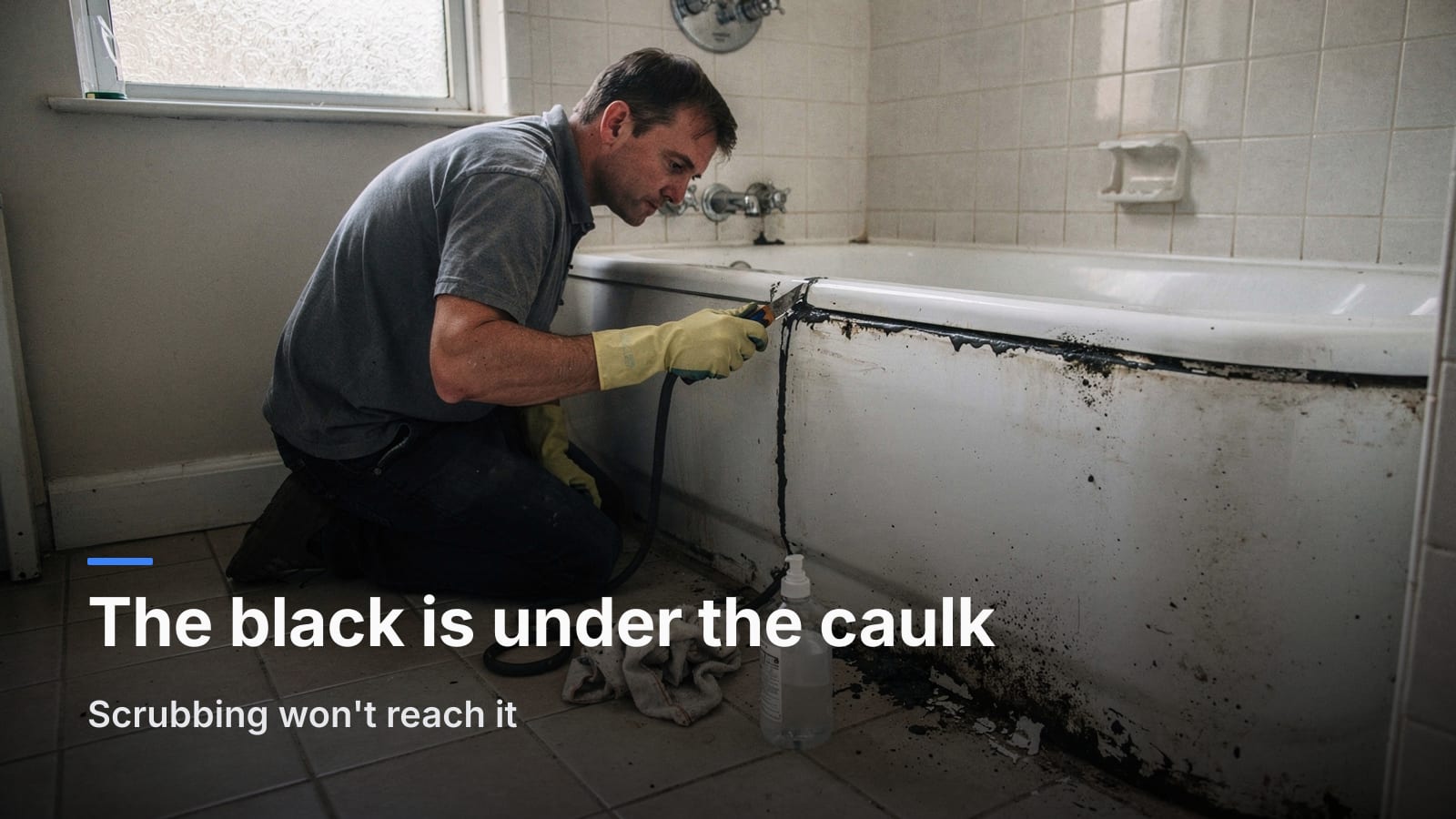
Look closely at the silicone bead where your tub meets the tile. If the black is inside the caulk — visible but not removable, like ink under glass — the silicone itself has been colonized. Water wicked in behind or beneath the bead, the mold grew in that film, and it's now under a clear layer of silicone you cannot scrub through.
This is the most common bathroom mold complaint, and the most commonly wasted effort. No amount of bleach paste fixes discolored silicone permanently. Bleach may lighten it for a week or two, but the growth is behind the surface and comes right back.
The fix is mechanical, not chemical:
- Cut the old bead out with a utility knife or caulk removal tool. Pull it away in one strip if you can.
- Scrape the joint clean, then wipe with rubbing alcohol and let it dry completely — genuinely dry, 24 hours if the joint was wet behind the old caulk.
- Re-caulk with a 100% silicone product labeled for kitchen and bath with a mildewcide. Tool it smooth so water runs off instead of pooling on a ledge.
- Keep the new bead thin and concave. Thick, lumpy caulk traps water.
While the old caulk is out, look at what's behind it. Dark, soft, crumbly substrate or a musty smell from the gap means water has been getting into the wall, and that's no longer a caulk job.
Grout is different. Grout is porous cement, so mildew sits in the pores rather than under a skin. It usually does clean up:
- A stiff nylon brush and a bathroom cleaner or a baking soda paste handles most of it.
- For stubborn black in grout lines, a diluted bleach solution (roughly one part bleach to ten parts water) applied, left 10 minutes, then scrubbed and rinsed, works. Ventilate the room, wear gloves, and never mix bleach with ammonia or other cleaners.
- If grout is cracked, missing, or spongy, regrout. Water moving behind tile is what eventually rots the wall board.
And if the growth is pink or orange rather than black, that's usually not mold at all — it's a bacterium that loves soap residue. We covered that pink film in the shower separately; it's harmless to most people and rinses away easily.
Bathroom ceiling mold: take this one seriously
Ceiling growth is the one that should make you slow down. Not because it's automatically dangerous, but because the ceiling isn't splashed with water — anything growing up there got there from humid air or from a leak, and both need a real answer.
Two very different causes look similar at first:
Condensation pattern. Growth is spread fairly evenly across the ceiling, worst directly above the shower or near a cold exterior corner. Paint may look dull, chalky, or freckled with gray-black dots. This is a ventilation problem, sometimes made worse by an uninsulated ceiling cavity that keeps the drywall surface cold enough to condense.
Leak pattern. Growth is concentrated in a ring, a streak, or a patch with a defined edge, often with a brown or yellow water stain, sagging, or a soft spot when you press gently. That's water arriving from above — a roof, a bathroom on the floor above, a supply line, a vent fan duct dumping condensate into the cavity instead of outside. Fix the water first. Cleaning is pointless until you do.
Our fuller guide to what ceiling mold looks like walks through those visual differences in more detail, including the cases where a "mold spot" turns out to be soot or a dirty air pattern.
Two things about cleaning painted ceilings:
- Never dry-scrub or dry-brush mold. That aerosolizes spores into a small enclosed room. Wipe with a damp cloth and a detergent solution instead.
- If paint is peeling or the drywall feels soft, cleaning won't work. Soft drywall means the paper facing has been eaten, and that section needs to be cut out and replaced.
The ventilation fixes that actually stop regrowth
Most bathroom mold is a ventilation story. If you do nothing else, do these.
Run the fan longer than you think. Turning it off with the light is the single most common mistake. The fan needs to run 20–30 minutes after you're done showering to pull out the moisture that's already in the walls and towels. A cheap timer switch or a humidity-sensing switch solves this permanently and is one of the best few-hundred-dollar upgrades in a house.
Confirm your fan actually moves air. Hold a single square of toilet paper against the grille with the fan on. If it doesn't stick, the fan is undersized, clogged, or venting into nothing. Pull the cover and vacuum the dust off the blades — a decade of lint halves the airflow.
Confirm it vents outside. A surprising number of fans dump into an attic or a soffit. That doesn't remove moisture from the building; it relocates the mold problem to your roof sheathing. The duct should run to a roof or wall cap, be as short and straight as possible, and be insulated where it crosses cold space so it doesn't rain condensate back down. If you've also spotted dark speckling around supply registers elsewhere in the house, it's worth reading up on black specks in AC vents — HVAC and bathroom moisture problems often turn out to be related.
Leave the door open afterward. Air has to come in for air to go out. A closed door with no undercut gap starves the fan.
Squeegee and dry. Thirty seconds with a squeegee on the glass and walls removes most of the water the fan would otherwise have to evaporate. Hang towels spread out, not folded. Leave the shower curtain pulled across to dry rather than bunched.
Watch for cold surfaces. If growth clusters on one exterior wall or corner, the issue may be insulation, not humidity. Warm wet air always condenses on the coldest thing in the room — the same reason window sills grow mold in winter.
Consider a hygrometer. A $12 humidity gauge on the vanity tells you whether the room is recovering. Under 50% within an hour of a shower is a good target.
When to stop cleaning and call someone
DIY is genuinely fine for grout, caulk, tile, glass and small painted patches. Gloves, an N95, the door and fan running, damp cleaning only.
Bring in a certified inspector or remediation contractor when:
- The affected area is larger than roughly 10 square feet — about a 3-by-3-foot patch.
- The ceiling is stained, sagging, or soft, or you suspect water from above.
- Growth keeps returning within weeks despite better ventilation and drying.
- There's a musty smell but nothing visible, which often means growth inside the wall or behind tile.
- Anyone in the household has ongoing respiratory symptoms, or there are infants, older adults, people who are immunocompromised, or people with asthma in the home. Public health agencies like the EPA and CDC are consistent that mold exposure affects sensitive groups more, and symptom questions belong with a doctor, not a cleaning guide.
Not sure whether you're looking at cosmetic mildew or something worth investigating? You can upload a photo for an instant AI mold analysis and get a probability read plus a fuller report by email. It's a screening aid — a fast second opinion before you decide whether to grab a brush or a phone — not a lab test or a substitute for a certified inspection.
Frequently asked questions
Is black mold in shower grout dangerous?
In most homes, no. The dark staining in grout is usually ordinary mildew and common molds growing on soap film, not toxic Stachybotrys, which needs continuously soaked porous material like drywall or wood to establish. It can still irritate people with asthma or mold sensitivity, so clean it damp rather than dry-brushing, and if you want to understand the distinction, our comparison of Stachybotrys and other common molds covers it.
Why does mold keep coming back on my bathroom ceiling?
Because the moisture is still arriving. Recurrence within a few weeks almost always means one of three things: the fan is undersized or not actually venting outside, it isn't running long enough after showers, or there's a slow leak from above. Cleaning treats the symptom; regrowth is the room telling you the cause is untouched.
Should I replace moldy caulk or clean it?
If the black is under the silicone surface and won't come off with a scrub, replace it — that discoloration is permanent. If it wipes off, clean it and keep the joint dry. As a rule, caulk that's cracked, peeling at the edges, or older than about five years in a daily-use shower is due for replacement anyway.
How do I stop mold in a bathroom without a window?
Ventilation becomes non-negotiable. Get an exhaust fan that's genuinely sized for the room and ducted outside, put it on a timer or humidity sensor so it runs 20–30 minutes after every shower, leave the door open to let replacement air in, and squeegee the walls and glass. A small dehumidifier or a portable fan pointed into the shower stall helps in the toughest cases.
Can I just paint over bathroom ceiling mold?
No. Paint doesn't kill mold, and a fresh coat over live growth peels or bleeds through within months. Fix the moisture source, clean and fully dry the surface, replace any soft drywall, then repaint — ideally with a bathroom-rated paint. Paint is the last step, never the fix.
Does a musty smell with no visible mold mean something's wrong?
Often, yes. A persistent musty odor in a bathroom usually points to growth you can't see — behind tile, under the tub surround, inside a wall cavity from a slow supply-line drip, or in the fan duct. Our guide on finding hidden mold when you can smell it covers where to look first.
If you've got a spot you're unsure about, upload a photo at /test for a free instant analysis — a quick first step, not a diagnosis.
Ready to put this into action?
Not sure what you are looking at? Upload a photo and get a free instant mold analysis from Mold Detector AI.
Launch Mold Detector AIRecommended next reads
- Is It Mold or Dirt? A Homeowner's Guide to Telling the Difference
- That Pink Mold in Your Shower? Here’s What It Really Is
- What Does Ceiling Mold Look Like? A Homeowner's Guide to Identification
- Black Specks in Your AC Vents: Is It Dust or Dangerous Mold?
- Mold on Window Sills: Why It Happens and How to Stop It for Good
- Is It Dangerous Black Mold? Stachybotrys vs. Other Common Molds
- I Smell Mold But Can't See It: A Homeowner's Guide to Finding Hidden Mold