Identification
Mold in HVAC Systems and Air Ducts: Signs, Causes, and What Actually Fixes It
Musty smell when the AC kicks on? Learn where mold actually grows in an HVAC system, what duct cleaning can and can't fix, and when to replace ductwork.
Quick answers
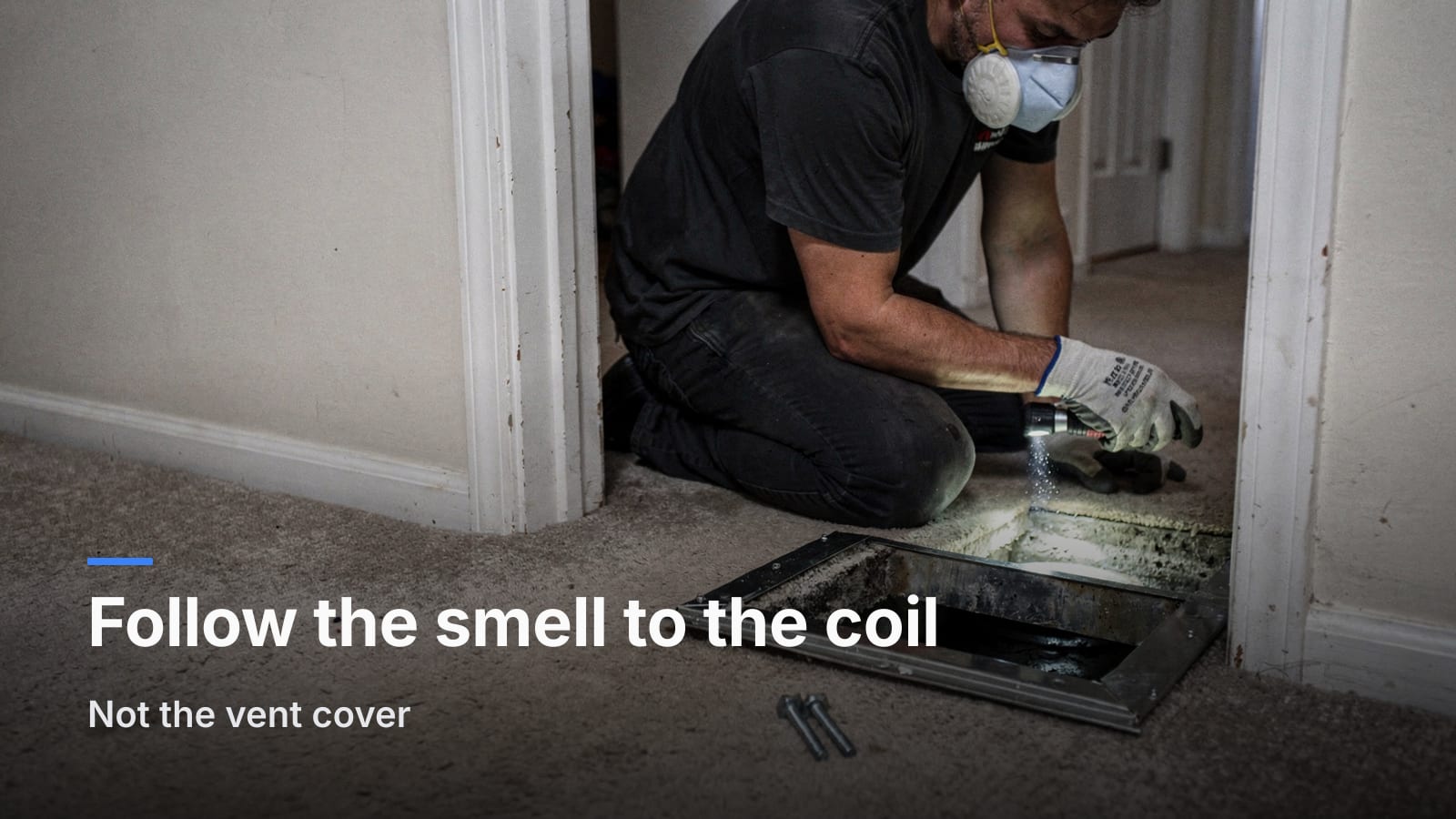
Does a musty smell when the AC turns on mean mold? Often yes — a smell that appears in the first 30 seconds of a cycle and fades usually points to biological growth on the evaporator coil or in the drain pan, not in the ducts themselves.
Where does mold actually grow in an HVAC system? Almost always where water sits: the evaporator coil, the condensate drain pan, and any duct insulation that's been wet from a leak or condensation.
Does duct cleaning get rid of mold? Cleaning removes dust and loose debris, but it can't fix the moisture causing growth, and it can't "clean" porous fiberglass duct liner that's already colonized — that gets replaced.
Is the black stuff around my vent covers mold? Usually it's dust and lint caught where room air meets cooler metal; mold is more likely if it's fuzzy, smears greenish or dark when wiped, or keeps coming back after cleaning.
When should I call a pro? If growth is visible inside the air handler, spreads across more than about 10 square feet of duct or insulation, or your symptoms reliably track the system running.
Air conditioning is a dehumidifier that happens to make cold air. That's the whole story of HVAC mold in one sentence. Every cooling cycle pulls moisture out of your indoor air and dumps it onto a cold metal coil, where it drips into a pan and (ideally) runs out a drain line. Add the fine film of dust that passes every filter, and you have a dark, damp, food-containing environment running on a timer all summer.
So mold in HVAC equipment isn't exotic. The useful questions are: where is it, how bad is it, and what actually fixes it versus what just moves the dust around.
Dust on the register vs. actual growth
This is the distinction most homeowners need first, because the vent cover is the only part of the system you can see without tools.
| Dust and lint | Mold growth | |
|---|---|---|
| Color | Gray, tan, lint-colored, sometimes dark gray-black | Black, dark green, olive, brown, sometimes white or pink-tinged |
| Texture | Flat, fibrous, fuzzy in a "clothes dryer" way | Fuzzy, speckled, or slick; sometimes raised dots |
| Pattern | Follows airflow lines — streaks fanning out from the slats | Blotchy, irregular, often concentrated at one corner or edge |
| Where | Face of the register, around the edges where air meets the wall | Inside the boot, on insulation, at the coil, on damp drywall around the vent |
| Wipe test | Lifts cleanly, leaves a clean surface | Smears, stains, or reappears within weeks |
| Smell | None, or faint dustiness | Musty, earthy, "wet basement" — strongest right when the system starts |
| What it means | Normal filtration and static | There is water somewhere in the system |
The single most telling detail: dust is on the outside of the register, in the airstream. Mold is usually past the register — on the inside surfaces, on fiberglass, on the sheet metal boot. If you can unscrew a register cover and look in with a flashlight and see nothing but clean galvanized metal, your black streaks are almost certainly dust.
We went deep on this exact call in Black Specks in Your AC Vents: Is It Dust or Dangerous Mold? — worth reading if the register face is your main concern.
The five places mold actually lives
1. The evaporator coil
This is the number one spot, by a wide margin. The coil is the cold aluminum-finned block inside your indoor air handler or furnace cabinet. During cooling season it is wet essentially the entire time the system runs. Dust that slips past the filter sticks to the wet fins and builds a biofilm in the spaces between.
Signs: musty odor that hits hardest in the first few seconds of a cycle and fades after a minute or two; reduced airflow; the system running longer than it used to. You generally need a service panel removed to see it.
2. The condensate drain pan and line
Under the coil is a pan that catches condensate and feeds a drain line. When that line clogs with slime — and it does, routinely — the pan stops draining and becomes a shallow standing-water tray inside your air handler. From there, the air blowing across it goes straight to every room.
Signs: water around the base of the furnace or air handler, a secondary drain line dripping outside, a float switch shutting the system off, or a smell that's less "musty" and more "stagnant pond."
3. Fiberglass duct liner and flex duct interiors
Many homes have ductwork lined with fiberglass insulation on the inside, or flexible duct with a fiberglass core. Fiberglass itself isn't food, but the dust embedded in it is, and once it gets wet, it holds water like a sponge. This is the material that often can't be salvaged.
Signs: visible dark patches on the liner when you look into a register with a flashlight; smell that doesn't improve after the coil is cleaned.
4. Window units and portable ACs
These are miniature versions of the same problem with less maintenance. Window units have a coil, a pan, and a foam filter, and most of them never get opened. A window AC that smells sour the moment it starts has biological growth on the coil or in the base pan, full stop.
The good news: these are cheap enough that replacement is a legitimate option, and small enough that a thorough cleaning is realistically a DIY job — outdoors, with gloves and an N95.
5. Mini-split heads
Ductless mini-splits are efficient and quiet, and they are notorious for odor. The blower wheel is a narrow squirrel cage sitting inches from a constantly wet coil, and residential mini-splits are rarely serviced on a schedule. If your mini-split puffs out a sour smell on startup, the blower wheel and drain pan almost certainly need a deep cleaning — a service most HVAC companies offer specifically for this.
Signs that point to the system rather than the room
Mold complaints get blamed on HVAC all the time, often wrongly. Here's what genuinely implicates the equipment:
- The smell tracks the cycle. Appears on startup, fades or steadies while running, gone when the system is off. Room mold smells constant.
- It's house-wide, not room-specific. If every room smells the same and no single room is worse, you're smelling something being distributed.
- Symptoms follow the thermostat. Congestion, scratchy throat, or headache that shows up in cooling season and eases when you open windows is a pattern worth noting — though plenty of other things cause the same pattern, so don't jump to conclusions. (Our guide to what mold exposure actually feels like covers what's typical and what isn't.)
- Dark staining at multiple registers at once. One dirty register is a dirty register. Six is a system.
And what points away from HVAC: a smell in one closet, one bathroom, or one corner of the basement; staining on a wall or ceiling near a plumbing wall; a smell that's worst when the system is off and the house is closed up. Those usually mean the moisture is in the building, not the equipment. If you can smell it but can't find it, this walkthrough on locating hidden mold is the better starting point.
What duct cleaning can and cannot do
Duct cleaning has a mixed reputation, and honestly, that's earned on both sides. A competent contractor with a negative-air machine and rotary brushes genuinely removes years of accumulated dust and debris from rigid metal duct. That's real work with a real result.
What it does well:
- Removes loose dust, construction debris, pet hair, and rodent leavings from hard-surfaced ducts
- Cleans the interior of the supply and return trunk lines
- Often includes blower wheel and coil cleaning — which, as above, is where the problem usually is
What it doesn't do:
- Fix the moisture. If the drain pan still backs up or the coil still gets drenched because of a sizing or airflow issue, growth returns in a season.
- Restore colonized fiberglass. Porous insulation that has supported growth is removed and replaced. There is no way to scrub the inside of a fiberglass fiber.
- Make a contaminated flex duct run clean. A rotary brush in a crushed, aging flex duct can do more harm than good.
- Justify "sanitizer" fogging as a standalone fix. Public health guidance from the EPA is fairly cautious on chemical biocides in ductwork. Anything sprayed into a duct is a finish step after physical removal, not a substitute for it.
If a company's proposal is "clean and fog, $400, done today" without anyone ever opening the air handler to look at the coil and pan, you're buying dust removal, not mold remediation. Ask specifically: will you pull the coil access panel? Will you photograph it? Will you check and clear the condensate drain?
When replacement is the honest answer
Nobody enjoys hearing this, but sometimes the right fix is new material:
- Internally lined fiberglass duct with visible growth — the liner comes out. In many systems that means replacing the duct section.
- Flex duct with wet or compressed insulation — flex duct is comparatively inexpensive to replace and nearly impossible to truly clean inside. Replacement is often cheaper than attempting restoration.
- A rusted, perpetually overflowing drain pan — new pan, and figure out why it overflowed.
- A window unit with growth throughout the base pan and coil — honestly, buy a new one.
- Duct board plenums that have been soaked — same logic as liner.
Rigid sheet metal duct, by contrast, is non-porous and cleans up well. If your system is all hard pipe, your odds of a cleaning-only solution are good.
What fixes it and keeps it fixed
Removing the growth without changing the conditions is a short-term win. The lasting fixes are boring and cheap:
- Keep the condensate drain clear. Flush the drain line at the start and middle of cooling season. Many lines have an accessible cleanout tee near the air handler.
- Use a filter that actually fits, and change it on schedule. Gaps around a loose filter let dust bypass straight onto the wet coil. A well-sealed MERV 8–11 is a reasonable target for most residential systems; check what your equipment is rated for before going higher, since too-restrictive a filter can hurt airflow.
- Get the coil inspected annually. A seasonal HVAC tune-up should include pulling the panel and looking. Ask them to.
- Keep indoor humidity in the 30–50% range. High humidity means more condensation everywhere, including on duct exteriors in unconditioned attics and crawlspaces.
- Seal and insulate ducts in hot attics and damp crawlspaces. Condensation on the outside of a cold duct running through a humid attic wets the insulation, and that's a classic hidden source. If your ducts run through a crawlspace, the crawlspace itself is worth a look.
- Run the fan after cooling, not constantly. Some thermostats offer a short post-cycle fan delay that helps dry the coil. Conversely, running the blower 24/7 in a humid climate can re-evaporate pan water back into the house.
- Fix leaks fast. A roof or plumbing leak that soaks duct insulation is a mold problem on a 48-hour clock, not a someday problem.
Safety, and where DIY stops
A few things are genuinely homeowner-appropriate: clearing a condensate drain, changing filters, wiping down register covers (wet, never dry-scrubbed — dry scrubbing launches spores), cleaning a window unit outdoors.
Past that, you're inside a sealed air distribution system, and disturbing growth in a duct is one of the more efficient ways to spread it through a house. Call a professional when:
- Growth is visible inside the air handler or across more than roughly 10 square feet of duct or insulation
- There's been a water leak, flood, or sewage backup near the system
- Odor returns within weeks of a cleaning
- Anyone in the house is immunocompromised, has asthma, or has respiratory symptoms that track the system
- You simply can't tell what you're looking at
Turn the system off before any inspection, wear gloves and an N95, and don't run the blower while you're poking around in a register. Our general safe cleanup guide covers the limits in more detail.
Not sure whether the dark edge inside your register boot is dust, rust staining, or growth? Photograph it with a flashlight held off to one side — raking light reveals texture that flat light hides — and you can run that photo through Mold Detector AI for a quick read before you decide whether to call anyone. It's a screening aid, not a lab test or an inspection, but it's a reasonable way to decide whether a photo is worth a professional's time.
Frequently asked questions
How do I know if there is mold in my air ducts?
Shut the system off, remove a few register covers, and look inside with a flashlight — you're looking for fuzzy or blotchy dark patches on the interior metal or on fiberglass liner, not the dust streaks on the register face. A persistent musty smell that appears when the system starts and no visible source elsewhere in the house is the other main indicator. Confirmation usually requires an HVAC tech or inspector opening the air handler.
Does duct cleaning remove mold?
It removes dust, debris, and surface growth from hard-surfaced ducts, and a good contractor will also clean the blower wheel and evaporator coil where most growth actually lives. It cannot restore porous fiberglass liner or flex duct that's been colonized, and it won't stop regrowth if the underlying moisture problem — usually a clogged drain or a chronically wet coil — isn't fixed.
Can a moldy air conditioner make you sick?
Mold in an air conditioner distributes spores and odor throughout the house, and public health agencies like the EPA and CDC note that mold exposure can trigger respiratory irritation, congestion, and allergy or asthma symptoms, particularly in sensitive groups. Whether any individual's symptoms are caused by it is a question for a doctor, not an article or an app. If symptoms consistently ease when you're away from home, mention that pattern to your physician.
How do I prevent mold in my HVAC system?
Flush the condensate drain line a couple of times a season, change filters on schedule with a filter that seals properly in its slot, keep indoor humidity between 30 and 50 percent, and have the coil visually inspected during annual service. In humid climates, insulating ducts that run through attics or crawlspaces prevents the exterior condensation that quietly soaks duct insulation.
Is it worth replacing flex duct instead of cleaning it?
Often, yes. Flex duct is relatively inexpensive, its fiberglass core can't truly be cleaned once it's held moisture and growth, and aggressive brushing can tear the inner liner. If a contractor recommends replacement over cleaning for wet or contaminated flex, that's usually an honest call rather than an upsell — though a second opinion never hurts.
Why does my mini-split smell worse than my central AC?
The blower wheel in a mini-split head sits very close to a constantly wet coil in a tight, hard-to-reach housing, and most residential units go years without a deep cleaning. Dedicated mini-split cleaning services exist precisely because of this; a standard filter rinse doesn't reach the wheel or the pan.
If you've got a photo of what's inside that register or around that vent, upload it at /test for a free instant read — a first step to help you decide what's worth a closer look.
Ready to put this into action?
Not sure what you are looking at? Upload a photo and get a free instant mold analysis from Mold Detector AI.
Launch Mold Detector AIRecommended next reads
- Black Specks in Your AC Vents: Is It Dust or Dangerous Mold?
- Mold Symptoms at Home: What Exposure Actually Feels Like
- I Smell Mold But Can't See It: A Homeowner's Guide to Finding Hidden Mold
- Is That Mold in Your Crawlspace? A Homeowner's Guide to Identification
- How to Clean Mold Safely — and When You Shouldn't Do It Yourself