Prevention & Solutions
How to Clean Mold Safely — and When You Shouldn't Do It Yourself
A practical guide to cleaning mold: the 10-square-foot rule, gear that matters, why bleach is overrated on porous surfaces, and when to call a pro.
Fast facts
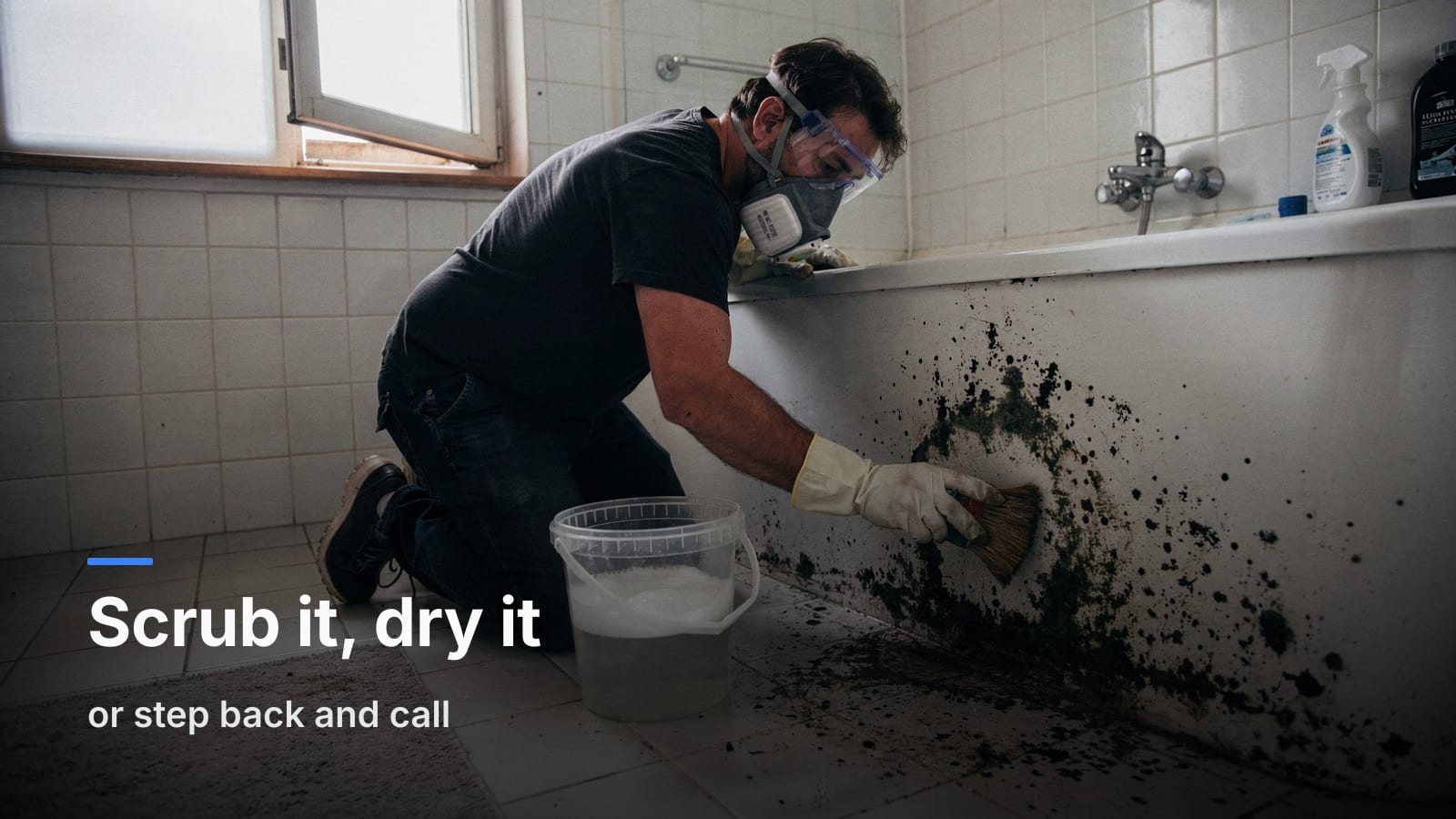
- How do I clean mold safely? For a small patch on a hard, non-porous surface, scrub with detergent and water, dry the area completely, and wear gloves, eye protection, and an N95 while you work.
- Does bleach kill mold? On hard surfaces bleach kills surface mold, but on porous materials like drywall and wood it mostly removes the color while the roots survive — detergent and water is the more sensible default.
- How much mold can I clean myself? Widely cited EPA guidance puts the DIY ceiling around 10 square feet — roughly a 3-by-3-foot patch — of surface growth on a hard material.
- When should I call a professional? Mold inside walls, in your HVAC system, after sewage or floodwater, anything recurring, or any situation where someone in the home is having symptoms.
- What has to be thrown away? Porous, saturated, or crumbling materials: soaked drywall, carpet pad, ceiling tiles, insulation, and most cardboard or paper goods.
Most mold people find at home is small, boring, and fixable in an afternoon. A dark bloom in the shower corner, a fuzzy patch behind a houseplant, a smudge on a window frame. Those are DIY jobs, and you don't need special chemicals or a contractor to handle them.
The trick is knowing where that line sits — because the same scrub-and-spray approach that works beautifully on tile can make things measurably worse on wet drywall. Cleaning mold badly doesn't just fail; it aerosolizes spores and moves the problem somewhere you can't see it.
Here's how to do the small stuff right, and how to recognize the jobs you should hand off.
First: is it actually mold?
Before you spend a Saturday on it, confirm what you're looking at. Plenty of dark smudges are soot from candles, dust welded to a cold surface by condensation, or mineral salts pushing through masonry. White powder on a basement wall is usually efflorescence rather than mold, and a gray film on a rarely cleaned baseboard is often just dirt.
Two quick field checks:
- Wipe test. Dirt and soot lift off cleanly with a damp cloth. Mold smears, resists, and often leaves a stain behind.
- Texture check. Mold tends to look three-dimensional — fuzzy, speckled, or slightly raised. Stains and soot lie flat.
If it's mold, the next question isn't "what kills it" — it's "how big is this, and what is it growing on?"
The 10-square-foot rule (and why it exists)
The EPA's homeowner guidance uses about 10 square feet of visible mold as the practical dividing line between a do-it-yourself cleanup and a job for someone with containment equipment. That's roughly a 3-foot by 3-foot square, or a strip a foot wide and ten feet long.
It's a rule of thumb, not a law of physics. The logic behind it is simple: below that size, the amount of spore-laden dust you stir up is manageable with basic precautions and an open window. Above it, you really want negative air pressure, plastic containment, and someone who does this for a living — otherwise you're just relocating the problem into your HVAC returns and your living room carpet.
Size isn't the only factor. Call a professional regardless of square footage if:
- The mold is inside a wall cavity, under flooring, or above a ceiling — visible growth is usually a fraction of what's behind it.
- There's growth in the HVAC system, ducts, or on the air handler. Running the system spreads it through the whole house. (Worth ruling out first, though — black specks at a vent are often just dust.)
- The water source was sewage, a septic backup, or river/storm floodwater. That's a biohazard job with different rules entirely.
- The mold keeps coming back after you clean it. Recurrence means the moisture source is still active and probably hidden.
- Someone in the home is immune-compromised, has asthma or COPD, is pregnant, very young, or elderly — or anyone is having symptoms you suspect are related.
- The material is structural — framing, subfloor, sheathing — and shows rot or softness.
If you're in one of those categories, stop reading the cleanup section and start calling. That's not upselling; it's the honest answer.
Fix the water first
This is the step people skip, and it's the reason most DIY cleanups fail.
Mold is a symptom. It grows because something is wet — a drip, a bad seal, chronically high humidity, condensation on a cold surface. Scrub the mold and leave the moisture, and you'll be scrubbing the same spot next month.
Before you clean:
- Find and stop the water. A leaking supply line, a failed shower caulk bead, a clogged gutter dumping against the foundation, a bathroom fan that vents into the attic instead of outside.
- Dry the area thoroughly. Fans, a dehumidifier, open windows on a dry day. Materials should be dry to the touch and stay that way.
- Get indoor humidity under control — generally below 50%. A $15 hygrometer tells you more than your intuition does.
Mold on window sills is the classic example: it's almost never a cleaning problem, it's a condensation problem, and no amount of scrubbing fixes cold glass meeting humid indoor air.
Protective gear that actually matters
You don't need a hazmat suit for a shower corner. You do need three things:
An N95 respirator. Not a surgical mask, not a bandana. A properly fitted N95 filters the fine particles you kick up while scrubbing. For larger or dustier jobs, a half-face respirator with P100 cartridges is a step up. This is the single most worthwhile item on the list.
Gloves. Long rubber or nitrile gloves that go past the wrist. Keeps cleaning products and mold off your skin.
Eye protection. Goggles without ventilation holes — safety glasses let particles in from the sides, and looking up at a ceiling means debris falls straight toward your face.
Also worth doing: wear clothes you can wash on hot immediately afterward, and close the door to the room you're working in while leaving a window open. You want air moving out, not circulating through the house.
What actually works on hard surfaces
Here's the part that surprises people: the recommended cleaner for most household mold is detergent and water.
Not a specialty product. Not bleach. Plain dish soap or a household cleaner, warm water, a stiff brush or scrub sponge, and physical removal.
The reason is that mold isn't a stain to be neutralized — it's a colony of physical material sitting on a surface. What matters is getting it off and then getting the surface dry. Detergent does that fine.
The basic procedure
- Mist the area lightly with water or your cleaning solution first. Never dry-scrub or dry-brush mold. Dry disturbance is how you send a cloud of spores into the air.
- Scrub with detergent and water. Work in from the edges. Use a brush stiff enough to lift growth out of grout lines and texture.
- Wipe up the residue with disposable cloths or paper towels. Bag them as you go — don't set a moldy rag on a clean counter.
- Rinse and wipe again.
- Dry the surface completely. Fan, towel, dehumidifier. This step is not optional; leftover moisture restarts the clock.
- Bag the waste, seal it, and take it outside rather than carrying an open bag through the house.
- HEPA-vacuum the surrounding area if you have access to one. A regular shop vac without HEPA filtration blows fine particles right back into the room.
About bleach
Bleach has a reputation it hasn't entirely earned. On a non-porous surface — glazed tile, glass, a fiberglass tub, sealed countertop — a diluted bleach solution kills surface mold and removes staining. That's a legitimate use.
On porous materials — drywall, bare wood, grout, plaster, fabric — bleach is mostly cosmetic. It's largely water, and the water soaks in while the chlorine stays near the surface. The visible black turns pale, you feel successful, and the growth underneath continues. Worse, you've just added moisture to a material that has a moisture problem.
A few other things worth knowing:
- Never mix bleach with ammonia or ammonia-containing cleaners. That combination produces toxic chloramine gas. Same caution applies to mixing bleach with vinegar or acidic cleaners.
- Bleach fumes in a small unventilated bathroom are their own hazard, especially for anyone with asthma.
- Vinegar is a gentler option some people prefer for light surface mold on hard materials. It's slower and smellier, but it's not a bad choice.
Whatever you use, the mechanical scrubbing and the drying are doing most of the work.
What you should throw away
Some materials can't be saved, and trying to save them wastes your time.
Usually discard:
- Drywall that's soft, stained through, or was saturated
- Carpet padding — it's a sponge and it never really recovers
- Ceiling tiles, acoustic panels, and insulation
- Cardboard boxes, paper files, books with visible growth
- Upholstered furniture with deep or widespread growth
- Wallpaper over affected drywall
Often salvageable:
- Tile, glass, metal, sealed stone, glazed porcelain
- Solid wood furniture with light surface growth (clean, dry, then assess)
- Hard plastics and finished trim
- Most washable clothing and linens — there's a real wash-versus-toss decision tree for moldy clothes worth reading before you bin anything sentimental
For carpet specifically, the answer depends on how deep it went and how long it stayed wet; surface-level growth on a rug that dried fast is a different story from a wall-to-wall carpet soaked for three days.
Mistakes that spread spores
These are the ones that turn a small problem into a whole-house problem:
- Dry-brushing or sanding mold. The worst thing you can do. Always dampen first.
- Running the HVAC during cleanup. It pulls contaminated air into ducts and redistributes it. Shut it off and cover nearby returns.
- Using a fan pointed at the wall. Directional airflow blasts particles across the room. Use fans to exhaust air out a window instead.
- Painting over mold. Mold-resistant paint prevents growth on clean surfaces; it does nothing over active growth except hide it for a while.
- Skipping the drying step. Cleaning without drying is a scheduled rematch.
- Tracking debris through the house. Bag waste in the room, seal it, carry it straight out.
- Cleaning a big area "a little at a time." Splitting a 40-square-foot job into four Saturdays doesn't make it a small job.
When to stop mid-job and call someone
Sometimes the scope reveals itself once you start. Put the brush down and pick up the phone if:
- You open a wall or pull baseboard and find growth far larger than what you saw
- The material crumbles or the framing feels soft
- You start coughing, wheezing, or getting headaches while working
- The smell is strong and clearly coming from somewhere you can't reach
- You find water damage with no obvious source
That last one matters. A musty smell with no visible mold usually means it's behind something — and tracking down hidden mold is a different skill set than cleaning it.
A certified inspector or remediation contractor has moisture meters, thermal cameras, containment barriers, and negative-air machines. For the jobs that need those tools, nothing in your garage substitutes.
Not sure how bad yours is?
If you've got a photo and you're genuinely unsure whether you're looking at a 20-minute cleanup or something that needs a pro, you can upload it for a free instant analysis. It'll give you a mold probability read and a fuller emailed report — useful as a first sanity check before you commit to a plan. It's a screening aid, not a lab test and not a substitute for a certified inspector, so treat it as a starting point rather than a verdict.
Frequently asked questions
Does bleach kill mold?
On hard, non-porous surfaces like tile, glass, and fiberglass, yes — diluted bleach kills surface mold and removes staining. On porous materials like drywall, wood, and grout, it mainly bleaches the color out while the mold's roots survive below the surface, and the water content can feed regrowth. Never mix it with ammonia or acidic cleaners.
What is the best thing to clean mold with?
Detergent and water, applied with a stiff brush, followed by thorough drying. Public health guidance generally favors physical removal over chemical killing, because dead mold still triggers reactions in sensitive people and still needs to come off the surface either way.
How big of a mold problem can I handle myself?
Roughly 10 square feet of visible surface growth on a hard material is the commonly cited DIY limit. But size isn't the only factor — mold inside walls, in ductwork, after sewage or floodwater, or in a home with someone who has respiratory issues belongs to a professional regardless of how small the patch looks.
Do I need a mask to clean mold?
Yes, for anything beyond a quick wipe of a small spot. An N95 or better is the minimum; a cloth or surgical mask won't filter mold particles. Pair it with gloves and non-vented goggles, and ventilate the room while you work.
Should I test the mold in a lab before cleaning it?
For most homeowners, no. The response to visible mold is the same regardless of species — remove it and fix the moisture. Testing is more useful when there's a health claim, a dispute with a landlord or insurer, or symptoms with no visible source. If you're curious about species and severity, our guide to telling Stachybotrys from common household molds covers what visual cues can and can't tell you.
Can I clean mold while my family is home?
For a small bathroom or window-sill patch, yes — close the door, ventilate, and keep kids and anyone with asthma out of the room until it's cleaned and dried. For anything larger, or if a sensitive family member lives there, it's reasonable to have them out of the house while you work.
Found something and not sure what you're dealing with? Upload a photo at /test for a free instant analysis — a useful first step before you decide whether to grab a brush or call a pro.
Ready to put this into action?
Not sure what you are looking at? Upload a photo and get a free instant mold analysis from Mold Detector AI.
Launch Mold Detector AIRecommended next reads
- White Mold on Concrete or Efflorescence? A Homeowner's Guide
- Is It Mold or Dirt? A Homeowner's Guide to Telling the Difference
- Black Specks in Your AC Vents: Is It Dust or Dangerous Mold?
- Mold on Window Sills: Why It Happens and How to Stop It for Good
- Can You Save Moldy Clothes? A Homeowner's Guide to Washing vs. Tossing
- I Smell Mold But Can't See It: A Homeowner's Guide to Finding Hidden Mold
- Is It Dangerous Black Mold? Stachybotrys vs. Other Common Molds