Health & Safety
Mold and Sensitive Groups: What Parents and Caregivers Should Know
Why babies, kids with asthma and older adults react more to mold, what symptoms look like in a child who can't explain them, and how to make a bedroom safer.
By Erik Short · October 15, 2026
Fast facts
- Are babies more sensitive to mold than adults? Generally yes — infants breathe faster relative to their size, spend hours at floor and crib level, and have developing immune and respiratory systems, so public health agencies treat them as a sensitive group.
- What are the signs of mold exposure in a baby? There's no single telltale sign; most commonly it looks like persistent congestion, cough, wheeze, red or watery eyes, or skin irritation that eases when the child is away from home.
- Is mold in a nursery dangerous? A small patch on a window sill isn't an emergency, but any visible mold in a room where an infant sleeps should be cleaned and the moisture source fixed promptly.
- Can mold trigger asthma in kids? Damp, moldy indoor environments are widely recognized by EPA and CDC as a trigger for asthma symptoms in children who already have asthma.
- Who else counts as sensitive? Older adults, people with COPD or chronic lung disease, anyone immunocompromised (chemotherapy, transplant, long-term steroids), and people with known mold allergies.
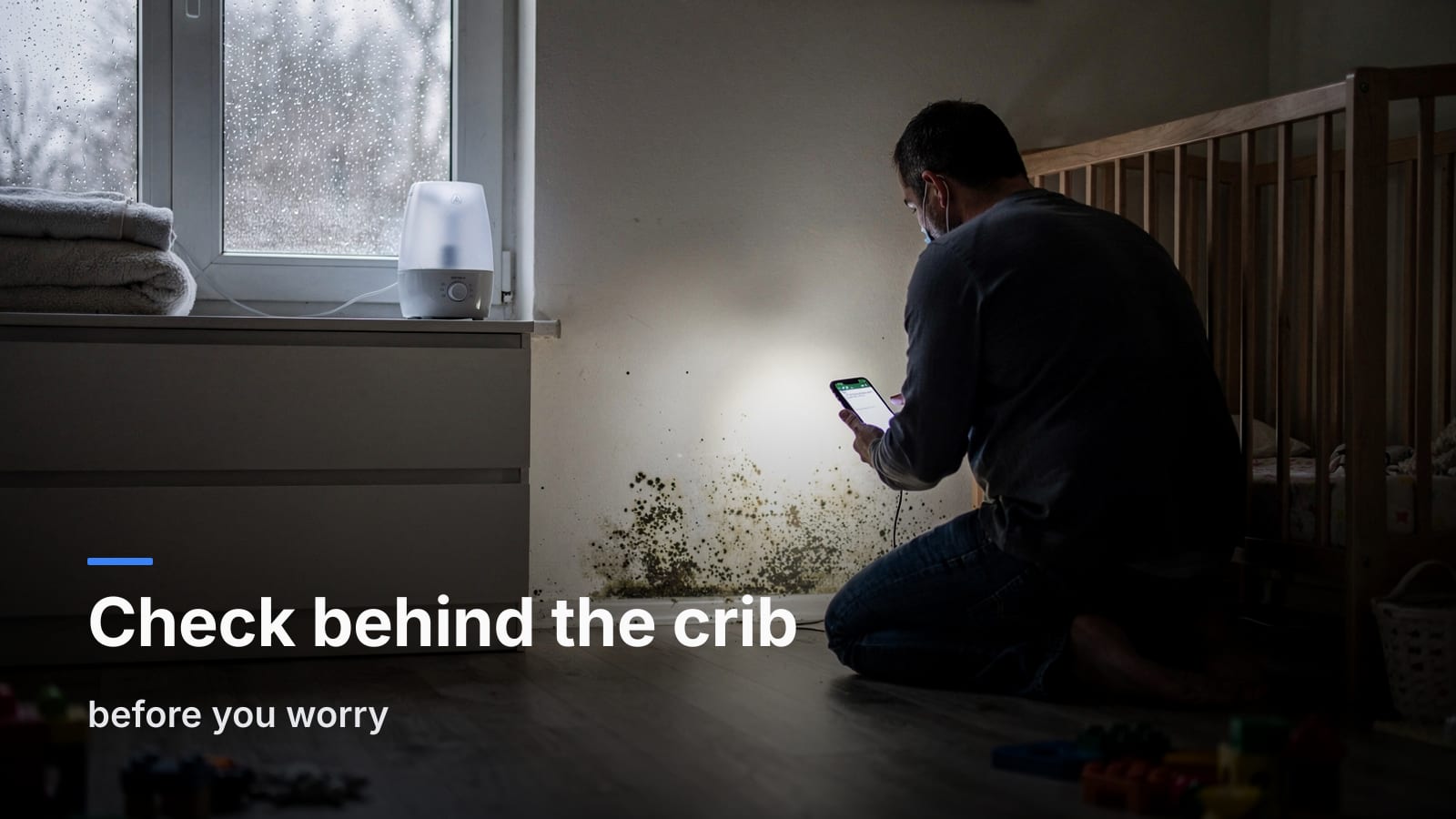
If you just found something fuzzy behind the crib or dark along the closet wall, take a breath. Finding mold in a home with a baby or an elderly parent in it is unsettling, but the overwhelming majority of these discoveries are small, fixable, and not a crisis. What matters is that you don't ignore it, and that you deal with the water that caused it — not just the stain.
Here's what actually makes certain people more reactive, what to watch for in someone who can't describe how they feel, where mold tends to hide in kids' rooms and daycare spaces, and a priority list for making a home safer.
Why some people react more
Mold is everywhere, indoors and out, at low levels all the time. Most healthy adults walk past a damp window sill and feel nothing. The difference for sensitive groups comes down to a few plain physical facts:
Smaller bodies, faster breathing. Infants and toddlers take more breaths per minute and move more air relative to their body weight than adults do. Whatever is in the room's air, they get proportionally more of it.
They live low to the ground. Babies crawl, sit, mouth toys, and sleep inches from the floor. Mold spores and the dust they ride on settle. A carpet that smells slightly musty is a non-event for a standing adult and an all-day exposure for a crawler. (If you're wondering what that looks like, our guide to mold on carpet and rugs covers the visual cues.)
Developing or declining immune systems. Young children's immune systems are still learning. Older adults' often respond less efficiently. Both ends of the age range tend to have a harder time shrugging off respiratory irritants.
Pre-existing conditions stack. Asthma, chronic allergies, COPD, cystic fibrosis, or any condition treated with immune-suppressing medication raises the stakes. For people who are significantly immunocompromised, certain molds can cause actual infections — rare, but a real reason not to let visible growth sit in the house.
Time in the house. An infant may spend 20+ hours a day indoors. A homebound older adult may rarely leave. Exposure is dose times time, and these groups max out the time side.
None of this means a square foot of mildew on the bathroom ceiling will harm your child. It means sensitive groups have less margin, so the threshold for "fix this sooner rather than later" is lower.
What symptoms look like in someone who can't explain them
Adults say "my nose has been stuffy since we moved into this apartment." A fifteen-month-old can't. With toddlers, infants, and some older adults with cognitive changes, you're reading behavior instead of words.
Things parents and caregivers commonly notice:
- Congestion or a runny nose that never quite resolves — weeks of "cold" with no fever
- A cough that's worse at night or first thing in the morning, especially in the bedroom
- Wheeze or noisy breathing, or more frequent inhaler use in a child who already has asthma
- Red, itchy, watery eyes, or eye rubbing
- Sneezing fits on entering a particular room
- Skin flares — eczema that's harder to control than usual
- Poor sleep, irritability, reduced appetite — nonspecific, but part of the picture when it comes with the above
- In older adults: more shortness of breath on normal activity, a lingering dry cough, or more frequent respiratory flare-ups
Two patterns are far more informative than any single symptom:
- Location. Symptoms are worse at home, worse in one room, or worse at night — and noticeably better on vacation, at grandma's house, or after a weekend away.
- Timing. Things changed after a leak, a flood, a basement finish, a new humidifier, or a move.
Those patterns are worth writing down and bringing to a pediatrician or doctor. They are also worth investigating in the house.
Two important caveats, said plainly. First, these symptoms overlap almost completely with ordinary viruses, seasonal allergies, dust mites, and pet dander — mold is one candidate among several, and often not the right one. Second, there is no way to diagnose "mold exposure" from a symptom list, and no home test tells you whether a specific person is being affected. Symptoms are a doctor's call; the house is an inspector's call. If you want a deeper walkthrough of what exposure typically feels like, we covered it in mold symptoms at home.
Get medical help promptly, rather than waiting, if a child has labored breathing, persistent wheeze, or a fever that doesn't fit, or if an immunocompromised person develops a new cough or shortness of breath.
Nursery and kids' room hotspots
Children's rooms have a specific set of moisture problems, and most of them are predictable.
Cool-mist humidifiers
The single most common one. Humidifiers are often run all winter in a nursery, and two things go wrong: the tank and base grow slime if they aren't cleaned every few days, and over-humidifying pushes room humidity to levels where mold grows on window sills, behind furniture, and in closets. Keep indoor relative humidity roughly between 30% and 50%. A $12 hygrometer on the dresser answers the question definitively. Empty, rinse, and dry the humidifier daily; deep clean it weekly per the manufacturer's instructions.
Window sills and frames
Cold glass plus warm humid room air equals condensation, and condensation pooling on a sill becomes black speckling in a matter of weeks. Nurseries are often the warmest, most humid room in the house, so they get it first. Our guide to mold on window sills walks through the fix.
Closets on exterior walls
Closed door, no airflow, cool exterior wall, stacks of clothing and stuffed animals against the drywall. Classic. Check the back wall and the stored items on the floor, especially in corner bedrooms.
Behind the crib or dresser
Furniture pushed flat against an exterior wall traps a cold, still pocket of air. Pull it out a few inches and look.
Beneath the crib and play mats
Foam play mats, rugs, and anything laid over a slab or basement-level floor can trap ground moisture underneath. Lift them occasionally.
Changing areas, diaper pails, and spills
Repeated wet events on carpet or near baseboards add up. A single soaked spot that never dried fully is a real starting point for growth.
Toys, strollers and car seats
Bath toys with a pinhole hold water forever — squeeze one and look at what comes out. Strollers and car seats that got rained on and were folded up damp develop musty spots on the straps and padding.
Daycare and school spaces
You can't inspect someone else's building, but you can ask reasonable questions: Has there been a roof or plumbing leak in the last year? Is there visible staining on ceiling tiles? Does the basement-level room smell musty? Any program worth using will answer without defensiveness.
A practical priority list for a safer home
If you do nothing else, do these in order.
1. Fix water first. Every piece of mold in a house is downstream of water. Drips under sinks, a running toilet seal, a roof leak, gutters dumping against the foundation, a sweating AC line, a washing machine hose. Mold can begin establishing within a day or two of a surface staying wet — which is why our post on the first 48 hours after a leak matters more than any cleaning product.
2. Control humidity. Target 30–50% RH. Run bathroom exhaust fans during and 20 minutes after showers. Vent the dryer outdoors. Use a dehumidifier in a damp basement. Don't over-humidify the nursery.
3. Deal with visible growth in sleeping areas promptly. A small patch — under roughly 10 square feet, on a hard, non-porous surface — is usually a reasonable DIY job. Larger areas, anything on soaked drywall or insulation, anything recurring, or anything in the HVAC system is where you call a professional.
4. Clean safely, and get the sensitive person out of the room. Gloves, an N95, eye protection, windows open, surfaces damp — never dry-scrub or dry-brush mold, which aerosolizes spores. Keep babies, kids and anyone with a respiratory condition out of the area until it's done and aired out. Details and the don't-do-it-yourself lines are in how to clean mold safely.
5. Improve airflow where air stands still. Pull furniture an inch or two off exterior walls. Leave closet doors cracked. Don't block return vents.
6. Reduce soft-surface reservoirs in the bedroom. Wash bedding and plush toys in hot water regularly. Consider hard flooring over wall-to-wall carpet in a basement-level or chronically damp room.
7. Check the systems that move air through the whole house. If you see growth around supply registers or smell musty air only when the system runs, that's worth looking into — see black specks in AC vents.
8. Document and escalate. Photograph what you find with the date. If you rent, put the request to your landlord in writing. If symptoms persist or the growth keeps coming back, bring in a certified mold inspector — they can find the source, test if needed, and scope the repair.
When to call a professional sooner
Don't wait on the sensitive-group math if any of these are true:
- Mold covers more than about 10 square feet, or you keep finding more as you look
- There was flooding, sewage, or long-term hidden water damage
- You smell mold persistently but can't find it — a common and frustrating situation we addressed in I smell mold but can't see it
- Growth is inside the HVAC system
- A household member is immunocompromised, has moderate-to-severe asthma, or has symptoms a doctor has connected to the home
- The same spot returns within weeks of cleaning
Calling an inspector isn't an overreaction. For a home with a newborn or an elderly parent in it, it's a sensible use of a few hundred dollars to stop guessing.
If you're not sure what you're looking at
Most of the spots people photograph in a nursery turn out to be dust, soap film, mildew on a sill, or an old water stain — not an active problem. Telling them apart by eye is genuinely hard, especially in a dim corner behind a crib. If you want a fast, no-pressure read before you decide whether to clean it yourself or call someone, you can upload a photo for an instant AI analysis. It's a screening aid to help you prioritize — not a lab test, and not a substitute for a certified inspector or your pediatrician.
Frequently asked questions
What are the signs of mold exposure in a baby?
There's no sign unique to mold. Caregivers most often report ongoing nasal congestion, a nighttime cough, wheeze, eye rubbing, sneezing, or eczema flares that improve when the baby spends time elsewhere. Bring those observations — especially the location and timing patterns — to your pediatrician, who can rule out more common causes.
Is mold in a nursery dangerous?
A small patch of growth isn't an emergency, but it shouldn't stay there. Move the crib out of the room while you fix the moisture source and clean the area, keep the baby out until the room has aired out, and call a professional if the area is large, recurring, or inside a wall.
Can mold trigger asthma in kids?
Damp and moldy indoor spaces are recognized by public health agencies as a trigger for asthma symptoms in children who already have asthma, and dampness in the home is associated with more respiratory symptoms generally. If your child's inhaler use climbs at home and drops elsewhere, mention it to their doctor and check the house for moisture.
How do I make a bedroom safer from mold?
Keep relative humidity between 30% and 50%, fix any leak immediately, pull furniture a couple of inches off exterior walls, leave closet doors slightly open, wash bedding and plush toys regularly, and clean or retire any humidifier that isn't being emptied and dried daily.
Should I move my family out of the house?
Rarely necessary for a small, localized patch. Temporary relocation makes more sense after major flooding, when remediation is extensive, or when a doctor advises it for someone with a serious respiratory or immune condition. A certified inspector can tell you the scope; your doctor weighs in on the person.
Does a musty smell alone mean there's a health risk?
A musty smell means moisture and microbial growth somewhere, even if you can't see it — it's a reason to investigate, not to panic. In a home with sensitive occupants, treat a persistent musty odor as a prompt to find and fix the water source.
Found a spot you can't identify? Upload a photo at /test for a free instant analysis — a first step to help you decide what to do next, not a diagnosis.
Ready to put this into action?
Not sure what you are looking at? Upload a photo and get a free instant mold analysis from Mold Detector AI.
Launch Mold Detector AIRecommended next reads
- What Does Mold Look Like on Carpet and Rugs? (And When to Replace It)
- Mold Symptoms at Home: What Exposure Actually Feels Like
- Mold on Window Sills: Why It Happens and How to Stop It for Good
- Mold After a Water Leak: What to Do in the First 48 Hours
- How to Clean Mold Safely — and When You Shouldn't Do It Yourself
- Black Specks in Your AC Vents: Is It Dust or Dangerous Mold?
- I Smell Mold But Can't See It: A Homeowner's Guide to Finding Hidden Mold