Prevention & Solutions
Mold After a Water Leak: What to Do in the First 48 Hours
A burst pipe or wet basement starts a clock. Here's how fast mold grows after a leak, what to dry first, what to throw out, and when to call a pro.
Fast facts
- How fast does mold grow after a leak? Commonly cited guidance from public health authorities puts visible growth at roughly 24 to 48 hours on wet, porous materials — so treat the first two days as a drying race.
- What matters more, cleaning or drying? Drying. Mold needs moisture; if the material is genuinely dry within a day or two, there's usually nothing to clean up.
- Can I handle a leak myself? Small, clean-water leaks caught early — a supply line under a sink, an overflowed tub — are often a DIY fan-and-dehumidifier job. Large areas, sewage, or water that's been sitting for days are not.
- What should I do first? Stop the water, protect yourself from electrical hazards, take photos before you move anything, then start pulling water out and moving air.
- When do I call someone? If more than about 10 square feet of material is wet, if water got into wall cavities, insulation, or your HVAC system, or if anything still smells musty a week later.
The clock starts when the water stops
A leak isn't a mold problem on day one. It becomes one somewhere between day two and day four, depending on temperature, airflow, and what got wet.
Mold spores are already in your house. They're in the dust on your baseboards and the fibers of your couch — that's normal and unavoidable. What they're missing is water. A burst supply line or a slow drip behind a dishwasher hands them everything they need: moisture, a cellulose food source (drywall paper, wood, carpet backing, cardboard), and room-temperature air.
That's why the advice for water damage is almost never "disinfect everything." It's "get it dry, fast." A bleached-out wet wall is still a wet wall, and mold will grow on it anyway.
So here's the honest framing: you probably can't prevent mold after a water leak by cleaning. You prevent it by winning the drying race.
Hour 0 to 2: stop, document, triage
Stop the water and stay safe
Shut off the supply at the fixture valve, or the main if you can't isolate it. If water is near outlets, a panel, or anything plugged in, kill the power to that area before you wade in. If the ceiling is sagging or bulging, stay out from under it — that's a bathtub's worth of water held up by wet paper.
If the water came from a sewer line, a toilet backup, a washing machine drain, or floodwater from outside, stop here and call a water damage restoration company. That category of water is a contamination problem, not just a wetness problem, and it's not a DIY job.
Photograph everything before you move it
Take more pictures than feels reasonable. Your phone timestamps them automatically, which is exactly what you want.
- Wide shots of each affected room, from the doorway
- The source of the leak itself, with the fixture or pipe visible
- Close-ups of water lines on walls and baseboards
- Furniture legs, rug edges, boxes in contact with water
- Anything you're going to throw out, before you throw it out
- A quick phone video narrating what happened and when you found it
Save receipts for anything you buy — fans, dehumidifier rental, a wet/dry vac, replacement materials. I'm not an insurance adjuster and this isn't legal or policy advice; your coverage depends entirely on your policy and your carrier. But every adjuster I've heard homeowners describe wants the same two things: proof of the condition before cleanup, and proof you acted promptly to limit the damage. Document both. Call your insurer early, even just to ask whether they want to see it before you start demo.
Triage what's in the room
Move it or lose it. In rough priority order:
- Get it off the wet floor. Anything sitting in water is wicking it upward. Lift furniture onto blocks or foil pads, or move it entirely.
- Cardboard and paper first. Boxes, books, photos, documents. Cardboard goes soft and moldy faster than almost anything else in your house.
- Textiles next. Wet clothes, linens, cushions. They can usually be saved if you get them into a wash and a dryer the same day — our guide on whether moldy clothes can be saved covers the laundry side.
- Electronics and upholstered furniture. Unplug, elevate, and get air moving around them.
Hour 2 to 24: extract, open, and move air
This is the part that actually decides whether you get mold.
Get the standing water out
A wet/dry vacuum beats towels by an enormous margin. Rent one if you don't own one. On carpet, go over the same area repeatedly and slowly — a carpet that looks "damp" can still be holding gallons in the pad underneath.
Open the cavity
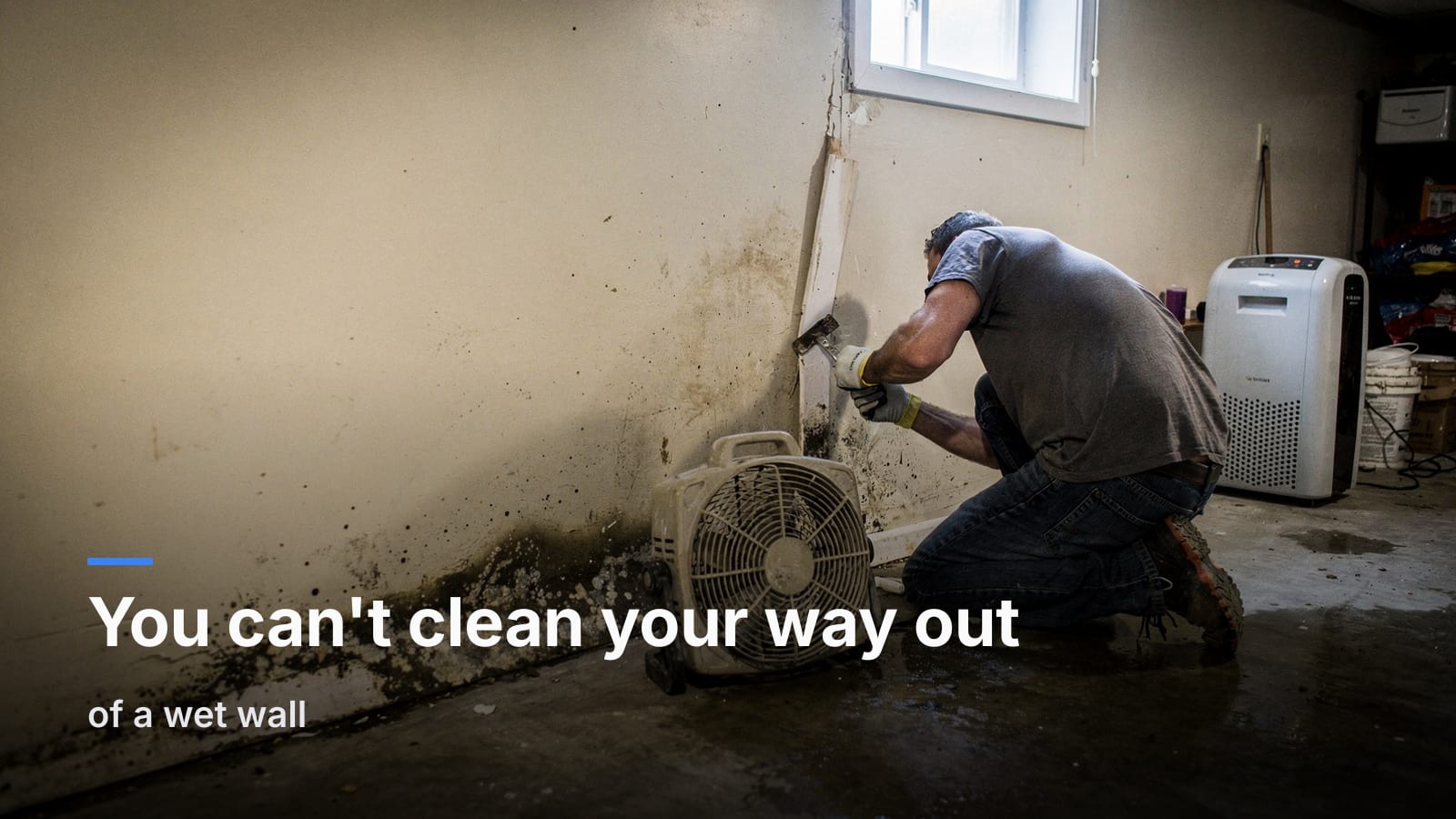
Water doesn't stay where you can see it. It runs down inside wall cavities and sits on the bottom plate. It soaks into insulation, which then holds that water against the framing for weeks.
For a wall that got wet along the bottom:
- Pull the baseboard off (gently, with a pry bar and a putty knife behind it, so you can reuse it).
- Drill or cut a few small holes in the drywall just above the floor, below where the baseboard sits, so air can get into the cavity. This is standard practice in restoration work and the holes disappear when the baseboard goes back on.
- If the insulation behind is wet fiberglass or any kind of cellulose, it has to come out. Wet insulation doesn't dry in place on any schedule that matters.
Set up drying properly
Three things working together:
- Dehumidifier, door closed, windows closed, draining to a floor drain or emptied twice a day. Target 30–50% relative humidity. A $20 hygrometer tells you whether you're actually succeeding.
- Air movers or box fans, aimed along surfaces at a low angle, not straight at them. You're trying to strip the saturated boundary layer of air off the wet material.
- Heat, mildly. Warmer air holds more moisture. Normal room temperature is fine; don't bake the room.
A common mistake: throwing the windows open. If it's cool and dry outside, that helps. If it's a humid summer day, you're importing moisture and defeating your dehumidifier. Check the outdoor dew point before you ventilate.
What to pull up now
- Carpet pad: gone. Pad almost never dries acceptably. Cut it out and replace it; it's cheap.
- Carpet itself: salvageable if it's clean water and you get it lifted, the pad removed, and air blowing under it within a day. If it sat wet for 48+ hours, plan on replacing. Our piece on what mold looks like on carpet has the visual cues for making that call later.
- Laminate flooring: usually a loss once the core swells.
- Solid hardwood: often recoverable with aggressive drying, but it may cup and need refinishing. Worth trying.
- Drywall that's crumbly, bowed, or soft to a thumb press: cut it out. Standard practice is to cut a clean horizontal line 12–24 inches above the highest water mark.
Hour 24 to 48: verify, don't assume
Dry to the touch is not dry. Drywall feels dry on the surface long before the gypsum core and the stud behind it are.
If you're going to buy one tool for this, buy an inexpensive pin-type moisture meter. Take readings on dry drywall in an unaffected room — that's your baseline — then compare the affected area. You want the wet areas reading the same as the baseline before you close anything up or call it done.
Keep fans and the dehumidifier running the full 48–72 hours, even after things look fine. Restoration pros routinely run equipment for three to five days on a moderate loss. Shutting down at hour 30 because the carpet feels dry is the most common way homeowners end up with mold in a wall six weeks later.
When to stop and call a water damage company
Call if any of these apply:
- More than roughly 10 square feet of material is wet (that's a 3x3 patch — not much)
- Water got into more than one room, or traveled downstairs
- Water reached insulation, a wall cavity you can't open, or under cabinets
- It's category 2 or 3 water: dishwasher/washing machine discharge, toilet overflow, sewage, or outdoor flooding
- Water entered HVAC ducts or an air handler (this one spreads the problem through the whole house — see our guide on black specks in AC vents)
- The material has already been wet for more than 48 hours when you found it
- Anyone in the house has asthma, a compromised immune system, or respiratory symptoms
Restoration companies have commercial dehumidifiers that pull five to ten times what a home unit does, plus thermal imaging to find water you can't see. For anything beyond a small, caught-early spill, they are genuinely the faster and cheaper path.
The one-week check
This is the step almost everyone skips, and it's the one that catches the problem while it's still small.
Seven to ten days after the leak, go back and inspect deliberately:
- Smell first. Get your nose close to the baseboard, inside the cabinet, down at floor level. A musty, earthy, damp-basement smell means something is still wet, even if you can't see it. We wrote a full walkthrough on tracking down mold you can smell but can't see.
- Look at the drywall paper right at the water line: fuzzy specks, dark freckling, a faint green or gray bloom, or paper that's separating from the gypsum.
- Check the underside of things — the back of the baseboard, under the carpet edge at the tack strip, the bottom of a cabinet toe-kick, the back face of furniture that sat against a wet wall.
- Watch for staining that spreads or darkens over a few days. A stable brown ring is probably an old water stain; growth changes. If you're not sure which you're looking at, water stain vs. mold breaks down the difference.
- Re-check with the moisture meter if you bought one.
If you find something at the one-week check, take a photo of it in good light before you touch it. That's useful for your insurer, and it's useful for identification. You can upload that photo for an instant AI read to get a quick sense of whether what you're looking at reads as mold or as staining — it's a screening aid for triage, not a lab test or a substitute for a certified inspector, but it helps you decide how urgently to act.
What safe cleanup looks like if you do find growth
For a small area — under about 10 square feet on a hard, non-porous surface:
- Gloves, eye protection, and an N95 respirator. A cloth mask does nothing here.
- Ventilate the area to the outside; close doors to the rest of the house.
- Never dry-brush or dry-sand mold. That aerosolizes spores. Wet the surface first with a detergent solution.
- Detergent and water is fine. Bleach is not required and does little on porous materials, where the growth is rooted below the surface.
- Porous materials with visible growth — drywall, carpet pad, insulation, ceiling tile — get removed, not cleaned.
- Bag debris in the room and carry it straight outside.
Our longer guide on cleaning mold safely and when not to covers the containment details and the clear lines where it stops being a homeowner job.
Frequently asked questions
How long after a leak does mold start to grow?
Mold can begin establishing on wet porous materials within about 24 to 48 hours under typical indoor conditions, which is the window commonly cited by the EPA and CDC. Visible colonies usually appear a bit later — day three to five — but by then it's already rooted.
How do I dry out a room to prevent mold?
Extract standing water with a wet/dry vac, remove wet carpet pad and insulation, open wall cavities at the baseboard so air can reach inside, then run a dehumidifier with the room closed and fans blowing across (not at) wet surfaces for at least 48 to 72 hours. Verify with a moisture meter rather than by touch.
Should I remove wet drywall myself?
For a small, clean-water area, yes — cut a clean horizontal line 12 to 24 inches above the water mark, wear gloves and an N95, and check for wiring and plumbing before you cut. For large areas, contaminated water, or anything above eye level where a ceiling might be holding water, hire it out.
Will mold grow if I dry a leak within 24 hours?
Usually not, if the material is genuinely dry throughout — not just dry to the touch. Surface dryness with a wet stud or saturated insulation behind it is the single most common reason mold shows up weeks after a leak that seemed handled.
Does my insurance cover mold from a water leak?
It depends entirely on your policy and the cause of the water. Many policies cover sudden, accidental discharge but exclude long-term seepage or lack of maintenance — call your carrier early, document everything with timestamped photos, and let them tell you what applies to your situation.
My basement flooded and dried out. Do I still need to check anything?
Yes. Check the bottom few inches of drywall, the sill plate, anything stored in cardboard, and the back of any furniture that was against a wall. Concrete can also show a white crusty deposit after drying that's often efflorescence rather than mold.
If something turned up at your one-week check and you're not sure what you're looking at, you can upload a photo for a free instant analysis as a first step before deciding whether to call someone.
Ready to put this into action?
Not sure what you are looking at? Upload a photo and get a free instant mold analysis from Mold Detector AI.
Launch Mold Detector AIRecommended next reads
- Can You Save Moldy Clothes? A Homeowner's Guide to Washing vs. Tossing
- What Does Mold Look Like on Carpet and Rugs? (And When to Replace It)
- Black Specks in Your AC Vents: Is It Dust or Dangerous Mold?
- I Smell Mold But Can't See It: A Homeowner's Guide to Finding Hidden Mold
- Water Stain or Mold? How to Tell the Difference on Walls and Ceilings
- How to Clean Mold Safely — and When You Shouldn't Do It Yourself
- White Mold on Concrete or Efflorescence? A Homeowner's Guide