Identification
Water Stain or Mold? How to Tell the Difference on Walls and Ceilings
Brown rings on your ceiling: water stain or mold? Learn the visual differences, why stains hide mold behind the drywall, and what to check above the spot.
Fast facts
- Is a brown ring on my ceiling mold or a water stain? Most brown rings with sharp, ring-like edges and a flat, smooth surface are water stains — dissolved minerals and wood tannins left behind as water evaporated.
- How do I tell mold from water damage? Mold has texture (fuzzy, speckled, or powdery), irregular clusters or dots, and often a musty smell; a water stain is flat, dry to the touch, and odorless.
- Can a water stain have mold behind it? Yes — the stain tells you water was there, and the hidden side of the drywall or the insulation above it is often damp enough to grow mold even when the visible surface looks clean.
- What should I do first? Find and fix the water source above or behind the stain, then check whether the stain is still damp or spreading.
- When should I call a professional? If the area is bigger than roughly 10 square feet, keeps coming back, involves the HVAC system, or anyone in the home has symptoms.
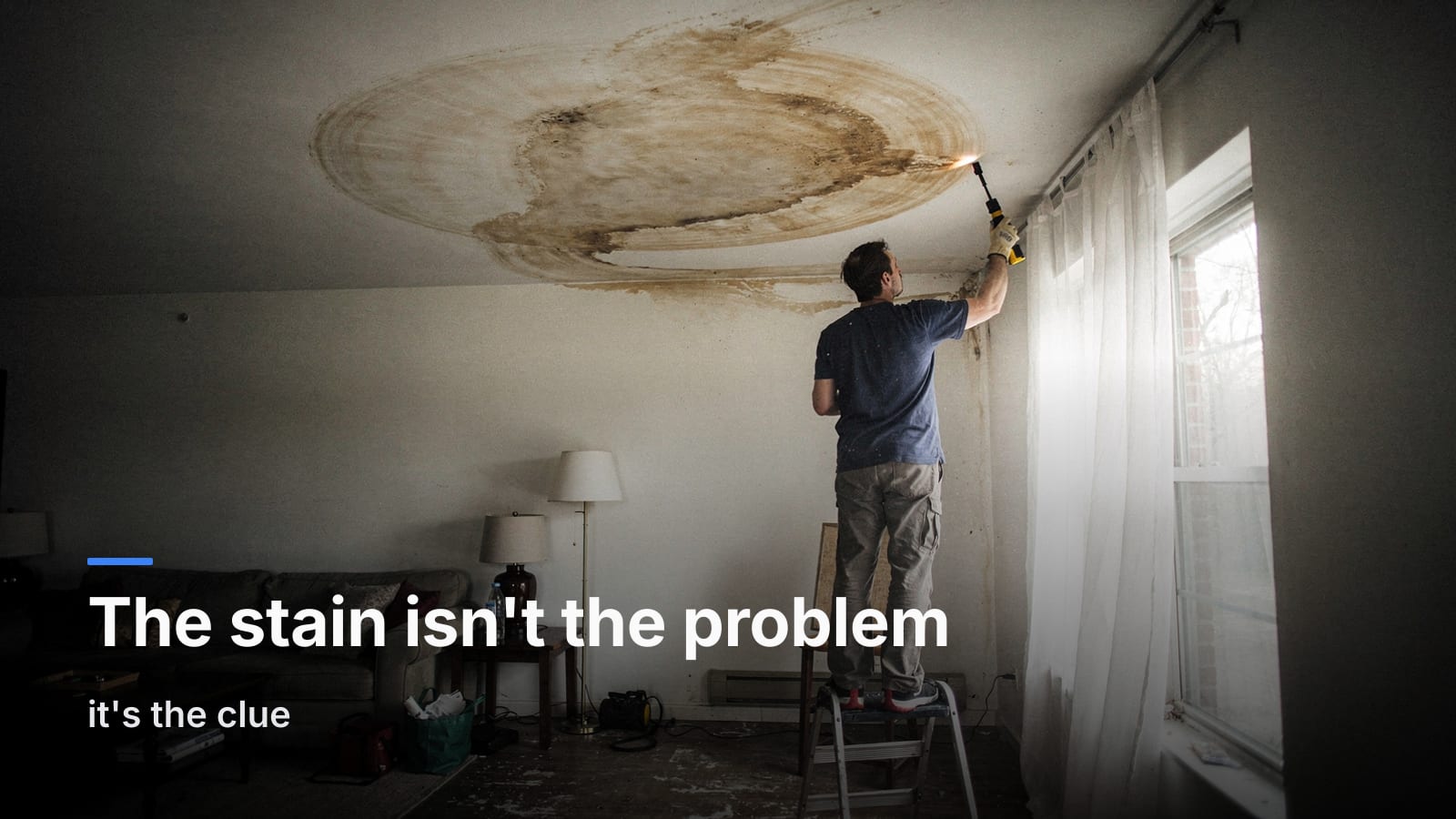
A brown ring on a ceiling is probably the single most common "is this mold?" photo homeowners take. It's an unsettling thing to notice from the couch — a coffee-colored halo you're pretty sure wasn't there last month. The good news: the stain itself usually isn't mold. The less good news: a stain means water got in, and water is the one thing mold needs that it can't make on its own.
Here's how to read what you're looking at.
Water stain vs. mold at a glance
| Water stain | Mold | |
|---|---|---|
| Color | Tan, brown, amber, yellow, or rust; sometimes a faint gray ring | Black, dark green, olive, gray, white, or pink; sometimes several colors in one patch |
| Edges | Concentric rings, like a tree stump or a coffee ring — darker at the border, lighter inside | Irregular, fuzzy, blotchy; often starts as scattered dots that merge |
| Texture | Flat and smooth; blends into the paint | Raised, fuzzy, velvety, speckled, or powdery; may smear if wiped |
| Smell | None | Musty, earthy, damp-basement smell |
| Spread | Grows only when water is actively leaking; stays the same size once dry | Keeps expanding as long as moisture is present, even slowly |
| What it usually means | Water passed through and evaporated, leaving minerals behind | Active or recent biological growth that needs moisture to survive |
If you want the texture cue in more detail, our guide to what ceiling mold looks like walks through the most common patterns — speckling around vents, fuzzy patches in corners, and the difference between surface growth and a stain.
What a water stain actually is
Water is a solvent. When it travels through a roof deck, insulation, joists, or drywall, it picks up whatever it passes: calcium and other minerals, iron from a nail head, tannins from wood framing, dust, dirt, the glue and paper facing in drywall itself.
Then the water evaporates — and everything it was carrying stays behind on the surface where it dried last. That residue is the stain. The ring shape forms because the outer edge of the wet area dries first, depositing the heaviest concentration of minerals right at the boundary. Multiple rings mean multiple wetting events, each one drying a little smaller than the last.
This is why water stains are flat. They're not growing on the ceiling; they are the ceiling, discolored. Run a gloved finger across one and nothing comes off, and nothing feels raised.
A few stain variations worth knowing:
- Yellow-brown with a hard, glossy edge — often tannins from wood framing above. Common with roof leaks and around skylights.
- Rust-orange pinpoints — a corroding fastener, nail pop, or pipe strap. Usually small and localized.
- Gray, soft-looking halo with no clear ring — may be condensation rather than a leak. Think uninsulated duct, bathroom fan dumping into the attic, or a cold spot where humid air keeps hitting a cold surface.
- White, chalky, crystalline — that's probably not a water stain at all. On masonry and concrete, that's efflorescence, which is a different animal entirely.
What mold looks like on or around a stain
Mold doesn't usually replace a water stain. It sits on top of it, or rings it, or shows up as a cluster near the wettest point.
Watch for:
- Dots inside the stain. Pinpoint black, green, or gray specks scattered across the brown field — like pepper on a tablecloth. Early growth almost always starts speckled.
- A fuzzy or velvety sheen that catches the light differently than the surrounding paint. Mold has nap; stains don't.
- Color that doesn't belong to water. Deep green, olive, or blue-green is biological. Water-borne minerals come out in the tan-to-rust family.
- Bubbling or flaking paint with dark material under it. Paint lifts when the drywall behind it is still wet, and that wet drywall paper is prime mold food.
- Soft, sagging, crumbly drywall. Once the gypsum gives, the cavity has been wet for a while.
- Smell. If the room smells musty and the stain is the only visible candidate, trust the smell. Odor often shows up before visible growth, and our guide on finding mold you can smell but can't see covers where to look next.
One nuance that trips people up: very dark, nearly black staining in a tight patch can be either. Severe water damage on drywall paper can darken dramatically, and so can mold. If it's flat, dry, and odorless, it's more likely heavy staining; if it has any texture or smell, treat it as possible growth.
Why a "clean-looking" water stain still matters
This is the part that gets underplayed. The visible side of your ceiling is the dry side. It's facing a heated, ventilated room with air moving across it. It dries fast.
The other side — the attic face of the drywall, the paper backing, the insulation sitting on top of it, the framing — doesn't get that airflow. It can stay damp for days or weeks after the surface looks fine. Mold can begin colonizing damp organic material within a couple of days under the right conditions, which is why public health agencies like the EPA emphasize drying water-damaged materials quickly rather than waiting to see what grows.
So a clean brown ring with no texture and no smell means one of three things:
- The leak was brief, everything dried fast, and there's nothing growing. Common and genuinely fine.
- The leak is fixed but things dried slowly, and there's some growth on the hidden side you can't see yet.
- The leak is still active, and the stain is the only symptom that's reached the surface so far.
You can't tell which from the surface alone. That's not a reason to panic — it's a reason to go look upstream.
What to check above the stain
Water travels. It runs along joists, follows pipes, and drips off the lowest point, which means the stain is often not directly under the source. Start at the stain and work outward and upward.
If the stain is on a top-floor ceiling:
- Get into the attic with a flashlight and look at the sheathing and framing directly above and uphill from the stain. Look for dark streaks, white or gray fuzz on the wood, rusted nail tips, or compressed, matted insulation.
- Check around roof penetrations — vent pipes, bath fan ducts, chimney flashing, skylights. Flashing failures are a classic source of repeating rings.
- Confirm the bathroom exhaust fan actually vents outside, not into the attic. A fan terminating in insulation will produce a stain every winter.
- Feel the insulation above the stain. Damp or compacted insulation holds water against the drywall for a long time.
If the stain is on a ceiling with living space above:
- Look for a bathroom, kitchen, or laundry directly above or near it. Check the toilet base, tub/shower surround, supply lines, and the washing machine drain hose.
- Check the caulk and grout in the shower above — failed sealant lets water into the floor assembly without any visible drip. Our bathroom mold guide covers what normal wear looks like versus a real problem.
- If there's HVAC above, check the condensate pan and drain line. A clogged drain overflows slowly and stains a ceiling in exactly one spot.
If the stain is on a wall:
- Trace up to the nearest window, roofline, or plumbing wall. Water from a window leak often shows up a foot or two below the sill.
- Check the exterior at the same height: siding gaps, failed caulk, missing kickout flashing, grade sloping toward the house.
On any stain, do two quick tests:
- Is it damp? Press a dry paper towel against it. Any transfer of moisture means the leak is active.
- Is it growing? Outline the stain lightly in pencil and date it. Check in a week and after the next heavy rain. A stain that grows has an open water path.
Safe next steps
Once you know where the water came from:
- Fix the source first. Cleaning or painting before the leak is fixed guarantees a repeat.
- Dry everything thoroughly. Fans, a dehumidifier, open the cavity if the drywall is soft. Wet insulation generally needs to be removed, not dried in place.
- Clean small, confirmed growth carefully. For hard surfaces under about 10 square feet, gloves, eye protection, an N95, and a damp wipe-down are usually enough. Never dry-scrub or sand mold — that puts spores into the air. We walk through the method, and the limits, in how to clean mold safely.
- Replace, don't scrub, soft materials. Porous drywall, ceiling tiles, and insulation that held mold don't reliably clean up.
- Prime with a stain-blocking primer before repainting — and only after the area is dry. Regular paint doesn't stop tannins; the stain will bleed right back through.
Call a professional when the wet area is larger than roughly 10 square feet, when the stain returns after you thought you'd fixed it, when the moisture has reached ductwork or the air handler, when drywall is sagging, or when anyone in the household is having symptoms they associate with the room. A certified inspector can use moisture meters and thermal imaging to see what's happening inside the assembly — something no photo, and no amount of staring at the ceiling, can do.
If you're genuinely unsure whether what you're looking at is staining or growth, you can upload a photo of the spot for an instant AI read on how mold-like it looks. It's a screening aid for deciding how urgently to act — not a lab test, and not a substitute for a certified inspection.
Frequently asked questions
How do you tell if a ceiling stain is mold or water?
Check texture, edges, and smell. A water stain is flat and smooth with concentric ring-shaped edges and no odor; mold is raised, fuzzy, or speckled with irregular borders and usually a musty smell. If it has any nap or any smell, treat it as possible mold.
Do water stains turn into mold?
The stain itself doesn't — it's just mineral residue. But the conditions that created it can absolutely grow mold, especially on the hidden side of the drywall or in wet insulation. A stain is best read as a leak clue, not a verdict.
Can I paint over a water stain?
Only after the leak is fixed and the material is fully dry, and only with a stain-blocking primer first. Painting over active moisture traps it, and plain paint lets tannins bleed back through within weeks.
What causes brown spots on a ceiling?
Most commonly roof leaks, failed flashing around vents and skylights, plumbing above the ceiling, HVAC condensate overflow, a bathroom fan venting into the attic, or condensation on cold surfaces. Rust-colored pinpoints usually mean a corroding fastener rather than a leak.
Should I cut open the ceiling to check behind the stain?
Not as a first step. Fix the source, dry the area, and watch the stain for a week or two. If the drywall stays damp, feels soft, smells musty, or the stain keeps returning, opening a small inspection hole — or having a pro check with a moisture meter — is reasonable.
Does bleach remove water stains?
It can lighten some discoloration, but it doesn't remove mineral deposits and it doesn't address what's behind the drywall. For appearance, a stain-blocking primer is the right tool; for suspected mold, see our safe cleaning guide first.
Not sure whether that ring is a stain or something growing? Upload a photo at /test for a free instant analysis — a quick first step before you decide what to do next.
Ready to put this into action?
Not sure what you are looking at? Upload a photo and get a free instant mold analysis from Mold Detector AI.
Launch Mold Detector AIRecommended next reads
- What Does Ceiling Mold Look Like? A Homeowner's Guide to Identification
- White Mold on Concrete or Efflorescence? A Homeowner's Guide
- I Smell Mold But Can't See It: A Homeowner's Guide to Finding Hidden Mold
- Mold in the Bathroom: Ceiling, Grout and Caulk — What's Normal and What's Not
- How to Clean Mold Safely — and When You Shouldn't Do It Yourself