Prevention & Solutions
When to Call a Mold Remediation Professional (and What They Actually Do)
Clear triggers for hiring a pro, what mold remediation actually involves, realistic cost ranges, questions to ask, and the quote red flags to walk away from.
By Erik Short · October 27, 2026
Quick answers
When should I call a mold remediation professional? Call a pro when the affected area is bigger than roughly 10 square feet, when mold is inside walls, HVAC, or under flooring, when it keeps coming back, or when someone in the home is health-sensitive.
How much does mold remediation cost? Small, contained jobs often land in the high hundreds to low thousands; whole-basement, crawlspace, or HVAC work commonly runs into several thousand dollars — but the real cost depends on how much material has to come out and whether the water source is fixed.
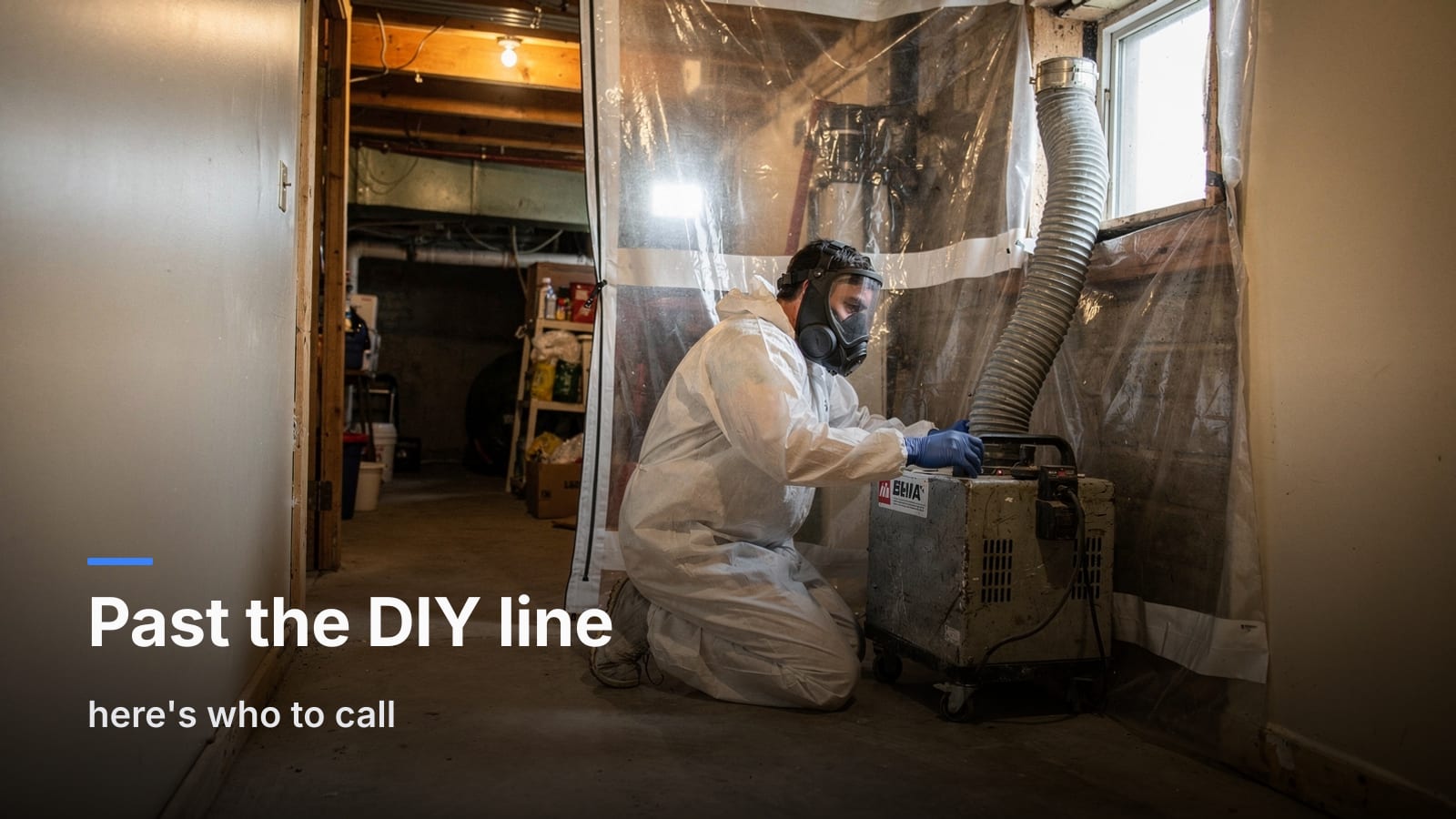
What does a mold remediation company actually do? They contain the work area, run negative air pressure, remove porous materials that can't be cleaned, HEPA-vacuum and wipe what stays, dry the structure, and verify the result.
Should the same company inspect and remediate? Generally no — the party that tells you how much mold you have shouldn't be the party that profits from removing it. Use an independent inspector for testing and clearance.
Can I wait a few weeks? If there's active water, no. Mold growth follows moisture, and the damage spreads into materials you can't see within days.
You've already done the hard part: you looked at the spot, you figured out it probably isn't dirt or efflorescence, and you've decided it's past the point where a spray bottle and a rag will fix it. Now you're staring at the harder question — who do I call, what will they do, and how do I know I'm not being sold something I don't need?
This is the decision post. No scare tactics. Just the lines that separate a Saturday project from a professional job, what remediation actually looks like when it's done right, what it should cost, and how to read a quote.
The DIY line: where it actually sits
Most public health guidance, including the EPA's, uses an area-based rule of thumb: a patch of mold smaller than about 10 square feet — roughly a 3-by-3-foot section — on a hard, non-porous surface is usually something a careful homeowner can clean. Bigger than that, or on materials that soak things up, and you're in professional territory.
But area is only one of the triggers. Here are the others that matter just as much.
1. The mold is inside something, not on it
Surface mold on tile grout is a cleaning problem. Mold inside a wall cavity, under laminate flooring, behind a bathtub surround, or on the back side of drywall is a demolition problem. You can't clean what you can't reach, and opening a cavity without containment spreads spores through the house.
If you can smell it but can't find it, that's the same category. Our guide to finding hidden mold when you can only smell it covers how to narrow down the source — but the actual opening-up is usually a pro's job.
2. HVAC is involved
Mold in the air handler, on the evaporator coil, or inside ductwork gets distributed to every room the system serves. This is one of the few situations where almost everyone agrees you should stop using the system and call someone. If you're seeing dark specks at the registers, read black specks in AC vents and mold in HVAC and air ducts first so you know what you're describing when you call.
3. There's an unresolved water source
A roof leak, a slab leak, a failed sump pump, chronic condensation, a supply line that let go while you were at work. Remediation without fixing the water is a rental agreement with the mold — it comes back. If you had a leak recently, the first 48 hours matter more than almost anything else.
Sewage or floodwater (what the industry calls Category 3 water) is a pro job regardless of how small it looks.
4. It keeps coming back
You cleaned it. Three months later it's back in the same spot. That's not a cleaning failure — it's a moisture diagnosis you haven't made yet. A good remediator (or a building-science-minded inspector) will chase the source instead of just re-wiping the surface.
5. Someone in the house is health-sensitive
Infants, older adults, people on immunosuppressive therapy, and people with asthma or a diagnosed mold allergy have a lower threshold for "just leave it alone and get someone in here." That doesn't mean panic — it means don't do the disturbing yourself and don't let the work happen around them. We cover this in more detail in mold and sensitive groups.
To be clear: we're not doctors, and no article can tell you whether a symptom is related to your home. If someone is feeling unwell, that's a conversation with a clinician.
6. You're selling, buying, or renting
Real estate changes the calculus. You want documentation: a written scope, invoices, and ideally third-party post-remediation verification. "I cleaned it myself with bleach" is not something you want to write on a disclosure form. Landlords and tenants, same deal — a paper trail protects both sides.
Inspector vs. remediator: why the distinction matters
These are two different jobs, and the conflict of interest when one company does both is real and obvious once you see it.
| Inspector / assessor | Remediator | |
|---|---|---|
| What they do | Find moisture, identify affected areas, sample if warranted, write a scope of work | Execute the scope: containment, removal, cleaning, drying |
| What you get | A report and a plan | A finished, cleaned, dried space |
| How they're paid | Flat fee for the assessment | By the size of the job |
| Conflict risk | Low, if independent | High, if they also wrote the scope |
If the company that tests your air is the company that bills you for removal, their incentive is to find more mold and scope more work. Some firms are scrupulous about this and some states actually prohibit the same licensee from doing both. But the clean version is: independent inspector writes the scope, remediator executes it, independent inspector returns for post-remediation verification (clearance).
That said, don't over-apply the rule. If you have a visibly moldy 4-by-6-foot patch of drywall under a window with an obvious leak, you may not need a pre-inspection at all. You need a leak fixed and drywall replaced. Testing shines when the extent is unclear, when health concerns are driving the decision, or when documentation matters.
What a mold remediation actually involves
Here's the sequence a competent contractor follows. Knowing it helps you tell a real scope from a hand-wave.
1. Assessment and moisture mapping
Moisture meters, sometimes a thermal camera, sometimes small inspection holes. The goal is to define the boundary of affected material — not just what's visible. Good contractors mark the containment line generously.
2. Containment
Plastic sheeting, zipper doors, taped seams. The work area is sealed off from the rest of the house. HVAC registers inside the containment get sealed so the system doesn't pull spores through the home.
3. Negative air pressure
A HEPA-filtered air scrubber exhausts air out of the containment, usually through a window. This keeps the work area at slightly lower pressure than the rest of the house, so air flows in through gaps rather than out. If a quote doesn't mention containment or negative air for anything beyond a tiny job, ask why.
4. Removal of porous materials
Drywall, insulation, carpet and pad, ceiling tiles, particleboard — porous materials with growth in them get cut out and bagged, not cleaned. Semi-porous framing lumber is usually cleanable: HEPA vacuum, damp wipe, sometimes abrasive methods like sanding or soda blasting on heavy growth.
Nobody should be dry-scrubbing moldy drywall with a wire brush and no containment. That's how a localized problem becomes a whole-house problem.
5. Cleaning and HEPA vacuuming
Everything in the containment — surfaces, framing, contents that stay — gets HEPA vacuumed and wiped. Antimicrobial products may be applied, but they're a finishing step, not the remediation. Removal and drying do the work.
6. Drying the structure
Dehumidifiers and air movers until framing and remaining materials hit target moisture content. This is the step that keeps the problem from returning. Ask for the readings.
7. Verification
Visual inspection at minimum: no visible growth, no dust, no odor, materials dry. For larger or health-driven jobs, third-party clearance testing. Then — and only then — reconstruction.
Note that reconstruction is usually a separate line item or a separate contractor. Remediation ends at a clean, dry cavity. Putting the drywall, paint, and trim back is its own cost.
Realistic cost ranges
Honest caveat first: mold remediation cost varies enormously by region, by access, and by how much material comes out. Anyone who quotes a firm number sight-unseen is guessing. With that said, here's the shape of it.
- Small contained job — a single bathroom wall, a closet, a section of ceiling under a fixed leak. Often several hundred to a couple thousand dollars.
- Mid-size job — a finished basement wall assembly, a large bathroom, multiple rooms from one leak. Commonly a few thousand.
- Large or complex job — whole basement, crawlspace encapsulation, HVAC system cleaning plus structural work, or anything involving extensive demolition. Can run well into five figures.
- Independent inspection with sampling — typically a few hundred dollars, depending on how many samples.
- Post-remediation clearance testing — usually in the same range as an inspection.
Drivers that move the number: square footage of removal, ceiling height and access (crawlspaces and attics cost more), whether contents need to be cleaned or packed out, whether the water source repair is in scope, and whether you need reconstruction.
Insurance: policies commonly cover mold when it results from a sudden, covered water event — a burst pipe — and commonly exclude mold from long-term seepage or deferred maintenance. Many policies have a specific mold sublimit. Read yours, photograph everything before anything is removed, and call your carrier early.
Questions to ask before you sign
- Are you licensed in this state, and are you insured? Ask for a certificate of insurance. Licensing requirements vary by state; some require mold licenses, some don't.
- What certifications do your technicians hold? IICRC is the common one in this trade.
- Who wrote the scope of work? If the answer is "we did, based on our own test," ask how they manage that conflict.
- Is containment and negative air included? Show me where.
- What are you removing versus cleaning, and why?
- How will you address the moisture source? If the answer is vague, that's your answer.
- What's your drying target and how will you document it?
- Will there be post-remediation verification, and by whom?
- Is reconstruction included?
- What's the written warranty, and what voids it?
Get at least two or three written quotes with itemized scopes. Compare the scopes, not just the totals — a cheap quote that skips containment isn't cheaper, it's smaller.
Red flags in a quote
- A price over the phone with no site visit. Nobody can scope mold work from a description.
- Free testing, paid removal, same company. Not automatically disqualifying, but ask how they separate the two.
- Fear language about "toxic black mold" and urgency pressure to sign today. Legitimate contractors explain; they don't perform. If the species question is on your mind, here's the honest version.
- "We'll fog/spray the whole house." Chemical treatment without physical removal and drying is not remediation.
- No mention of the water source. The single most reliable sign a job will fail.
- Vague line items — "mold treatment: $4,800" with no breakdown.
- Cash-only, no written contract, no insurance certificate. Walk.
- Pressure to skip clearance testing on a job where it was originally recommended.
When you're honestly not sure yet
Plenty of people land here with a spot that might be past the line and might not be. A few things worth ruling out first: dark marks near vents or above candles are sometimes soot rather than mold, and a brown-ringed discoloration on a ceiling is often an old water stain with no growth at all. If it is mold but it's small and on a hard surface, our guide to cleaning it safely — and when not to will tell you whether you can handle it.
And if you want a fast gut-check before you start calling contractors, you can upload a photo for an instant AI analysis. It's a screening aid — it gives you a mold probability and a plain-language read on what you're looking at, which is useful for deciding whether this is a phone-call situation. It is not a lab test and not a substitute for a certified inspector, and no photo tool can see inside a wall.
Frequently asked questions
How much does mold remediation cost?
Small contained jobs often run from several hundred to a couple thousand dollars; larger basement, crawlspace, or HVAC jobs commonly reach several thousand and can exceed ten thousand with extensive demolition. Cost is driven mainly by how much material must be removed, how hard the space is to access, and whether reconstruction and the water-source repair are included. Get itemized written quotes from two or three contractors.
What does a mold remediation company do?
They contain and depressurize the work area, remove porous materials that can't be salvaged, HEPA vacuum and clean what remains, dry the structure to a documented target, and verify the result before reconstruction. A good one also identifies and addresses the moisture source — or tells you clearly which trade needs to.
Do I need a mold inspection before remediation?
Not always. If the cause and extent are obvious — a known leak with visible growth on one wall — you may go straight to a remediator. An independent inspection is worth it when the extent is unclear, when you smell mold but can't find it, when health concerns are driving the decision, or when you need documentation for insurance or a real estate transaction.
Can I stay home during mold remediation?
Often yes, for small jobs with proper containment in a room you can avoid. You may want to relocate for larger projects, if the work is in a bedroom or central living area, if the HVAC system is affected, or if anyone in the household is health-sensitive. Ask the contractor directly what the containment plan is and which rooms stay usable.
How long does mold remediation take?
A small single-room job is often one to three days including drying; larger projects run a week or more, and reconstruction adds time on top. Drying is usually the step that sets the schedule — rushing it is how problems come back.
Are mold remediation companies regulated?
It varies by state. Some states license mold assessors and remediators and prohibit the same company from doing both on one property; others have no specific licensing at all. Ask about state licensing and about technician certifications such as IICRC, and always ask for proof of liability insurance.
If you're still deciding whether your spot crosses the line, upload a photo at /test for a free instant analysis — a useful first step, not a diagnosis.
Ready to put this into action?
Not sure what you are looking at? Upload a photo and get a free instant mold analysis from Mold Detector AI.
Launch Mold Detector AIRecommended next reads
- I Smell Mold But Can't See It: A Homeowner's Guide to Finding Hidden Mold
- Black Specks in Your AC Vents: Is It Dust or Dangerous Mold?
- Mold in HVAC Systems and Air Ducts: Signs, Causes, and What Actually Fixes It
- Mold After a Water Leak: What to Do in the First 48 Hours
- Mold and Sensitive Groups: What Parents and Caregivers Should Know
- Is It Dangerous Black Mold? Stachybotrys vs. Other Common Molds
- Mold or Soot? How to Read Black Marks on Walls and Ceilings
- Water Stain or Mold? How to Tell the Difference on Walls and Ceilings
- How to Clean Mold Safely — and When You Shouldn't Do It Yourself